On January 28th- February 04th 2017 about one week I had birding in Raden Soeryo GP Forestry. There are a few birding sites in the area that I have visited such as the hot spring “Cangar”, Watu Ondo Bridge, Gajah Mungkur, and Sendi.
Many birds are interesting and beautiful that I can see on these premises, especially in the hot spring “Cangar” and Watu Ondo Bridge. Compared to other places I have visited before, the birds in Raden Soeryo GP Forestry are much more easily found and approachable.
While I was drinking and eating fried foods, the birds would come by themselves around the stall near the hot spring. Javan FlamebackChrysocolaptes strictus, Grey-headed CanaryFlycatcherCulicicapa ceylonensis, White-crowned ForktailEnicurus leschenaulti, Little Pied FlycatcherFicedula westermanni, Indigo FlycatcherEumyas indigo and other birds, often small insect foraging on trees near stall.
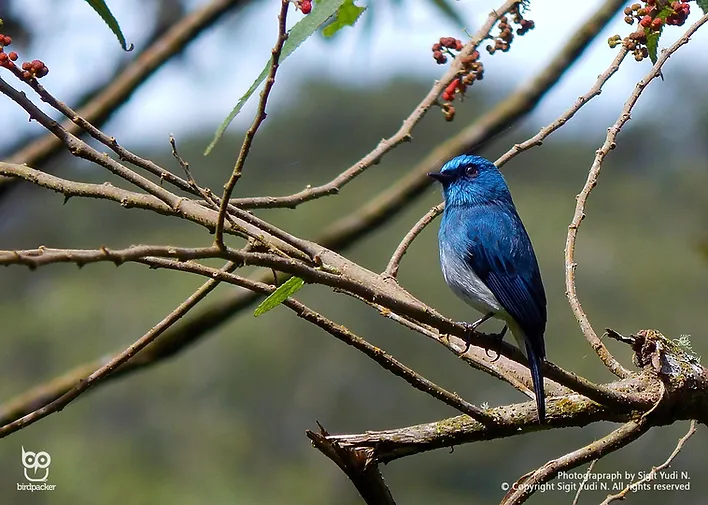
However, out of all of the birds, Indigo Flycatcher (Eumyas indigo indigo) is one bird that caught my attention. When I was eating “Sempol” (typical food of this place) on the edge of the road bridge Watu Ondo, four individuals of Indigo Flycatcher approached me.
Two birds were perched close together on Casuarina junghuhniana. The distance of approximately two meters away from where I was standing was very obvious and very beautiful. And the shiny metallic blue when exposed to sunlight.
The two birds were chirping softly, a very beautiful done repeatedly. When one individual chirps, other individuals will replay with a chirp while slightly bowed head. This behavior is observed for about five minutes, before the birds fly away.
The two birds are male and female which will perform the courtship display of its preliminary breeding cycle. It is based on breeding information of Indigo Flycatcher that are known in February-August and December.
Indigo Flycatcher found only in Montane and submontane primary and moss forests, from 900 m to 3000 m; generally less frequent above 2600 m. of Java island, Indonesia.Beautiful moment I have rarely encountered before. A perfect birding and delicious food!
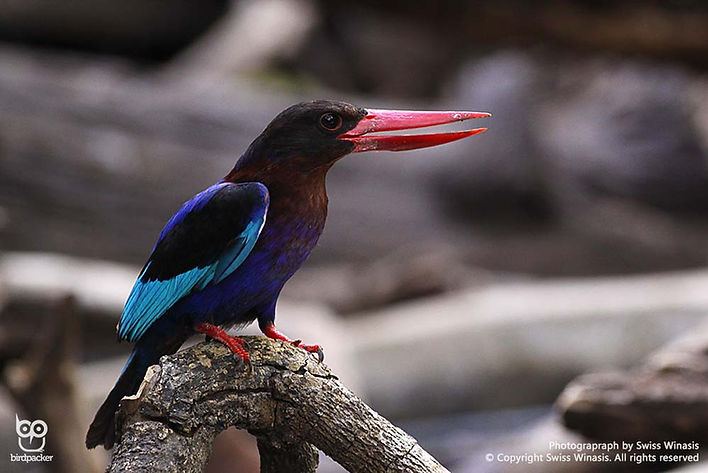
A total of 5 species of birds in Raden Soerjo Greater Park Forestry successfully photographed by our guest named Muhid on 22 July 2017 in just about 1.5 hours. In one day we had to change location 3 times. The first is the apple plantation area in Batu. There we entered into birdhide starting at 05.30 am to photograph Javan KingfisherHalcyon cyanoventris.
Our birdhide lies parallel to the tree with a distance of 8 meters, very enough for the 500mm lens to get full frame images. It did not take long for a Javan Kingfisher Halcyon cyanoventris to land at the top of an apple tree in front of us. Quickly our guests photographed the bird and got a picture of Javan Kingfisher’s front body. About 5 minutes later, the bird flies from the apple tree.
The morning weather conditions were less friendly, because the sun was covered by fog. So the birds, especially the Javan Kingfisher which became our target, were too lazy to perch and sunbathe. Until 07.30 am the target has not been seen again, we finally have to move to Raden Soerjo Greater Park Forestry. Arrive at the location at 08.00 am.
We went straight to Sunda Warbler’sSeicercus grammiceps nest in the feeding phase. We take a distance of about 8 meters, so as not to disturb the adult to feed the chicks who has not been out of the nest. A pair of adult birds are seen alternating in and out of the nest and catching insects near the nest to give to the chicks who are waiting for the food.
Young-Indigo-FlycatcherSunda-Warbler
It did not take a long time to get a photo of this bird. When an adult bird carrying food is brought to the nest, it will surely be near the nest long enough while looking around. That moment is a good time to take pictures. Suddenly the flocks of Sunda MinivetPericrocotus miniatus and Blue NuthatchSitta azurea perched on a tree near the entrance of the location. We guide guests to the place. Easily these two species can be recorded by our guests.
After the flock was gone, we proceeded to the parking lot. Immediately we met two young Indigo FlycatcherEumyas indigo individuals. The bird perched on a bush about 30 cm above ground level.
The two young individuals moved from one branch to another branch near the parking lot. 10 minutes later we saw an adult individual perched on a pine tree on a twig as high as 6-7 meters from the ground. We enjoyed the behavior of all three Indigo Flycatchers up to Lesser Forktail Enicurus velatus coming near us. The endemic bird landed on the ground to look for the insects behind the leaf litter.
After getting some photo frames, the bird goes to the small river on the opposite side. A brief bird-photography trip at Raden Soerjo Greater Park Forestry finished.
With the large number of kingfishers (8 of 14 kingfisher in Java) in one area (we called “One Stop Birding”), making Baluran more attractive and valuable to visit, especially for birding and bird-photography.
Kingfisher has wide distribution around the world, though concentrated in the Southern Hemisphere continents, the kingfishers are well-known as fish-eaters, but despite their name, most members of this family take a wide variety of vertebrate and invertebrate prey. Characteristics are cartoon include a relatively large head with a long dagger-shaped bill, short legs and weak feet, in which the second and third front toes are fused at the base. Beside the unique it forms, all kingfishers has colorful feathers made this creatures are one of photogenic birds in front of lenses bird-photographer. One example, Alan McFadyen a wildlife photographer from Scotland has spent patience for six years since 2009 (about 4200 hours and produced 720 thousand photos) to get the perfect photo of Common Kingfisher.
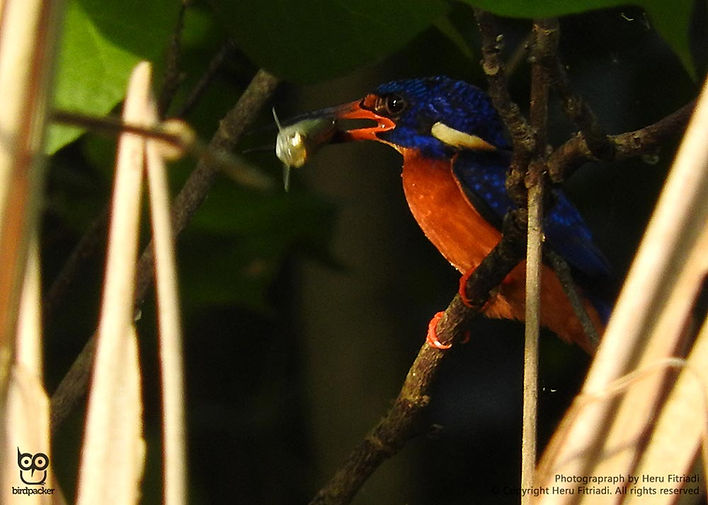
At the end of 2016, Heru Fitriadi photographed Ruddy Kingfisher in Baluran National Park for the first time. Heru is local residents who live in the Wonorejo village, directly adjacent to the National Park. Increasingly the number of birds in Baluran National Park added from the record of Ruddy Kingfisher, as well as the number of species of kingfisher. Heru meet this bird in Bama beach while searching for Mangrove Blue Flycatcher. Did not find it, suddenly he saw a red figure perched on a branch that is not too high from the ground. Then he approached the object, and with his camera he took some portraits and eventually knows that a red figure is Ruddy Kingfisher. The next day he revisited the area again but the bird did not appears until today. Besides Ruddy Kingfisher, Baluran National Park has seven others, there are:
1. Collared Kingfisher
Undoubtedly the commonest kingfisher in Indonesia, and probably the whole of south-east Asia, this species is a familiar sight on overhead wires and telegraph poles in cities, towns and other anthropogenic habitats. In Baluran, it is almost annoyingly abundant, occupying every available habitat, although it is rarely seen in the savanna. Its raucous call, usually given from an exposed tree perch, betrays its presence throughout the day. On the coast, at low tide, is often seen perched on isolated rocks or tree stumps on mudflats, habitats shared with the somewhat similar, migratory Sacred Kingfisher.
2. Sacred Kingfisher
A breeding resident of Australia, this species migrates north and west during the austral winter to New Guinea and much of Indonesia, including Java and Bali, but only occasionally reaching as far as Sumatra. In Java it is common along the coast from April to September, and in Baluran, is mainly associated with mangrove forests. It typically perches on low branches and aerial roots of mangrove trees, but also often alights on mudflats and sandy beaches, as well as moored boats and poles.
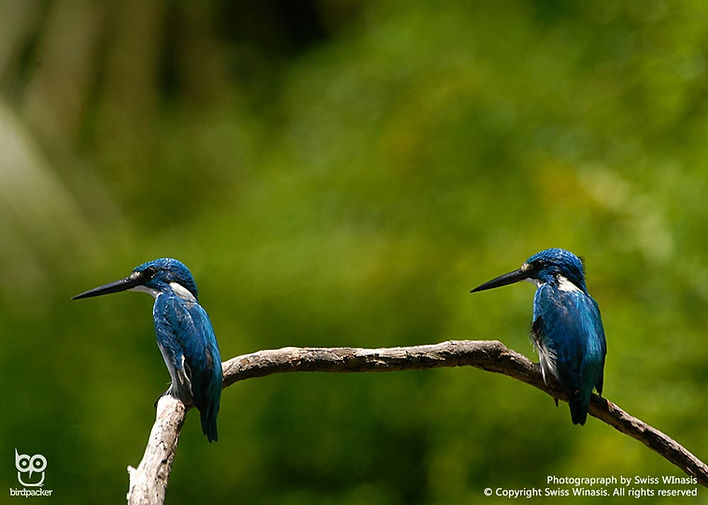
3. Cerulean Kingfisher
Also called Small Blue Kingfisher, this species is endemic to Indonesia, being found only from Sumatra to Sumbawa. In Baluran, it is common in coastal mangrove forests as well as fish ponds, and is often seen perched low on mangrove stilt roots or on the top of stumps or poles in the middle of ponds, from whence it dives into the water to catch aquatic invertebrates and small fish. In such open habitats, it can also be seen flying from one location to another, like a bullet travelling just above the water surface.
4. Blue-eared Kingfisher
This species has the largest geographical range of the local dwarf kingfishers, stretching from India to Sulawesi and Lombok. In Baluran, however, it is not an easy bird to find due to its small population and restricted distribution, apparently limited to the dense littoral forest at Bama and along Bajulmati River. Here it perches unobtrusively on horizontal branches or roots just above the water, periodically plunging into the water to spear small fish, which are then carried to another perch, bashed against the substrate until dead, then swallowed head first.
5. Oriental Dwarf Kingfisher
Ranging from Peninsular Malaysia through the Greater Sundas to Sumba, this beautiful species is one of the latest additions to the Baluran checklist. It was first found in Baluran in 2011, when one individual was seen on Curah Uling, a rain-fed river in evergreen forest, and in Manting block coastal forest. This species normally lives in the vicinity of streams and pools within lowland forest, where it feeds on aquatic insects and small fish. As with other dwarf kingfishers, while watching for prey this bird often jerkily bobs its head, while keeping the rest of the body perfectly motionless. As the Rufous-backed Kingfisher hybridizes with the more widely-distributed ‘Black-backed Kingfisher’ in several parts of its range, both are now usually treated as subspecies of a single species, the Oriental Dwarf Kingfisher (C. erithaca).
6. Banded Kingfisher
The only member of its genus, this species is unusual among kingfishers in that the female has a completely different plumage to the male. A denizen of lowland and hill forest, it ranges from Thailand through the Greater Sundas, but is generally rare in Java and entirely absent from Bali. In Baluran, it is possibly the rarest of the kingfishers, having been recorded only from the crater of Mount Baluran. It prefers undisturbed forest with a dense canopy, where it perches at a range of heights, and feeds on various grounddwelling invertebrates and lizards.
Female Banded KingfisherMale Banded Kingfisher
7. Javan Kingfisher
This beautiful and most elusive kingfishers is found only on Java and Bali, yet is surprisingly common in wetlands and fields throughout these islands. Widely-distributed in Baluran, it is easiest to observe in open habitats such as paddy-fields, yet is also occurs in forest with dense canopy such as in the crater of Mount Baluran. Perching on a low branch or at the top of a pole or thatched roof of a pondok (cottage), it swoops down on its prey, which consists of eels, frogs, lizards and large insects (Mason and Jarvis 1989).
I had the opportunity to visit Raden Soerjo Greater Park Forestry, Malang. The area is a mountainous forest on the slopes of Arjuno-Welirang-Anjasmoro mountains. This place is one of the best locations to birding/bird watching and bird photography typical Javan mountain birds I have ever visited. There are two birding sites I’ve visited, Watu Ondo waterfall and hot spring baths Cangar. Visiting this place always makes eyes amazed with the beauty of the landscape and the colorful birds hopping among the leaves.
This second chance to visit the area, I was accompanied by a courtier of Birdpacker, Waskito Kukuh Wibowo, Nurdin Setio Budi, Swiss Winnasis, Ahmad Yanuar, Arif Budiawan and M. Hilmi. Thanks are the highest and lift the cap for those who have guided observation wholeheartedly. For nearly a week of observation, 31 species can be observed very well. Of the 31 species observed, I’ll tell you the highlights from day to day.
Day 1, Monday, December 19, 2016
I arrived at the Watu Ondo waterfall at noon, too bad. Fortunately, my observations at the very special place. Though it was daylight, there were still a lot of birds that could be enjoyed. Flame-fronted Barbet is one bird that is very easily found and photographed on the first day. A kind tree from the family piperacea that was bearing fruit became its favorite food and we can find these birds easily very closely. This bird is one of the endemic birds of Java with the dominant color green, very pretty.
Flocks of Sunda Minivet break my focus while observing and photographing barbets. Dominant orange contrasting strongly with green leaves around, makes it such a beautiful flower that broke-fracturing. This bird is endemic to the highlands of Sumatra and Java, very easy to seen in this place.
Later I was invited to the site, not far from the parking lot Watu Ondo waterfall and its location is easy to reach. After waiting a while, finally a Javan Hawk-eagle appeared and perched on a tall tree. I tried to take pictures with a 400mm lens, but it was still very far to reach.
Not long from the first encounter with the Javan Hawk-eagle, it persistently reappeared. This time perched lower than before. Even had flown right over our heads. Even had flown right over our heads. Finally I succeeded in photographing Javan Hawk-eagles from a short distance. Yeay!
On the first day I was also guided to observe the Mountain Leaftoiler’s nest. The Nests laid on top of the plant that are not too high. Several times the birds were seen carrying food into the nest. Most likely the eggs had already hatched a few days ago and now in parenting by both parents. I succeed in shots when the birds return to the nest.
Day 2, Tuesday, December 20, 2016
I was very lucky because the next night I stayed in the area, so I could birdwatch and photograph birds earlier than before. Luckily the weather was quite bright despite the night it rained. Some birds appear gathered in the courtyard of the pavilion which is filled with grass. Interestingly, among the flocks, there are several Common Myna. Its population in several places in Indonesia is the result of the introduction, mainly from domestic birds loose. Distribution of Common Myna is actually in Afghanistan to Western China, Southeast Asia and the Malay Peninsula.
After breakfast, I continue the observations in the park around the hot spring Cangar. Several kinds of small to medium sized birds such as the Little-pied Flycatcher, Indigo Flycatcher, Blue Nuthatch, Ruddy Cuckoo-dove can be easily found here. Even photographing Ashy Drongo that can be found in the tree behind the public toilet of this hot spring. Similarly, along the small stream close to the hot spring, it could meet with Grey Wagtail and Lesser (Sunda) Forktail.
From the park area I continue observations to the jogging track. Footpath through the woods located behind the hot spring Cangar. The sounds of Lesser Shortwing very loud along the way. However, to observe and photograph it took extra patiences. Besides small size, agile movements, and the color of the body is brown perfect for camouflage in the thick bush.
There are also birds that hide in the bush, but more easily observed and photographed on this path, b. Small-sized brown with white eyebrows can be found easily along the jogging track. The bushes along the track have become a favorite location for hunting small insects or spiders.
Day 3, Wednesday, December 21, 2016
I was accompanied by Waskito and Nurdin to birding in Watu Ondo waterfall. The three main targets are the Pink-headed Fruitdove, Lesser (Sunda) Forktail, and Lesser Shortwing. For the first target, I headed to a large tree that bears fruit. Waskito and Nurdin said that the tree is visited by a Pink-headed Fruitdove every day. A Pair of Pink-headed Fruitdoves foraging on that tree which the fruits are drying up. Endemic birds to Sumatra and Java, seen very pretty with a head purple and green dominate the body. Flame-fronted Barbet also foraging at the same tree. Combo!
The second target is easier than before. The location right behind the canteen, a small river crossing on the edge of the canteen is a good habitat for Lesser (Sunda) Forktail. We can wait for the birds to arrive while enjoying coffee or tea in the canteen. Camouflage tent did not need to be photographed. We can use the canteen kitchen as a safe place to observing or photograph the birds.
As we were chatting and drinking tea in the canteen, a Pied-Shrike Babbler perched on one of the trees near the canteen. This bird was seen eating a caterpillar. Likewise at the same time, the group of small birds such as Javan Grey-throated White-eye, Blue Nuthatch, Sunda Bulbul, and Sunda Minivet arrive. I get confused about which one should be photographed first.
Although I already saw Lesser Shortwing on the second day, to photograph these birds needs extra effort, patience and being smart. Waskito and Nurdin guide me to photograph Lesser Shortwing in the nest. Incidentally they’ve been monitoring the nest for a few days. I was lucky to have been guided by them. However, I am only able to photograph these birds while in the nest. I succeeded in getting a few frames before the birds left the nest for food. I was also able to photograph Sunda Warbler.
Day 4, Thursday, December 22, 2016
There are two kinds of birds being targeted on the fourth day, Orange-spotted and Sunda Bulbuls. Although both are easy to find, for 4 days of observation I have not gotten a chance to photograph it from an ideal distance. To fulfill this desire we return to Watu Ondo waterfall.
Shortly after enjoying a coffee in the cafeteria, I heard the sound of Orange-spotted Bulbul and moved to the trees near the parking area, where the birds were singing. Several Orange-spotted-Bulbuls were eating the fruits from that Piperacea’s tree. Finally, I managed to get several frames of these endemic birds.
Next we move towards the bridge Watu Ondo, not far from the waterfall to photograph the Sunda Bulbul. Soon, targets were found. Several Sunda Bulbuls were eating the fruit that was right near the bridge. They were not sensitive to the presence of us who were close enough around less than 10 m from where the bird was eating. Just like the previous target, I succeed to get a photo of Sunda Bulbul.
Flame-fronted BarbetLittle-pied FlycatcherMountain Leaftoiler on the nestSunda BulbulMale Sunda MinivetPied Shrike-babblerAshy Drongo
Raden Soerjo Greater Park Forestry is one of the remaining natural montane-forest in Java. Located in the west-slope of mount Arjuno-Welirang-Anjasmoro (3,339 m asl), has a total area of 27868.30 hectares and has a special place for birding.
This area is a mountainous plateau that stretches from the North-South. A bumpy topography of the region and mountainous with an altitude of 1000-3339 m asl. Slope level reaches 30-90% with annual rainfall ranging between 2500-4500 mm. Temperatures at night ranged from 5-10°C. Whereas in the dry season can reach 4°C. The humidity is quite high, ranging from 42-45% (lowest) to 90-97% (the highest).