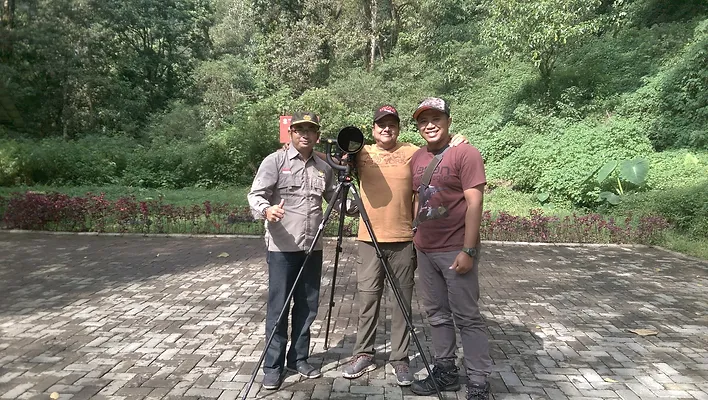
We are so happy finishing our three days (30 July – 01 August 2017) bird photography trip in Tretes Nature Tourism Park , Raden Soerjo GP Forestry and Batu Apple Farm with a Chinese group that series of Bird Photography tour Surabaya-Makassar-West Papua.
In this delightful trip cooperated with Sulawesi Bird and Wildlife Photography Tour and Malang Birding Tour.
The main target birds are Javan Banded PittaPitta guajana and Javan KingfisherHalcyon cyanoventris, also the other that we might find on the site.
Meeting point in the International Airport of Juanda, Surabaya on the afternoon 30 July then we drove to a hotel near Tretes Nature Tourism Park, Pasuruan for staying at night.
At 31 July morning we started looking for Javan Banded Pitta at it birdhide. We spent fullday birding there and got photo of birds such as Horsfield’s BabblerMalacocincla sepiarium, Blue Whistling ThrushMyophonus caeruleus and the first target male and female of Javan Banded Pitta.
In the afternoon we changed location into Raden Soerjo Greater Park Forestry at Malang, East Java. We were looking for Javan Hawk EagleNisaetus bartelsi and the other montane birds. After looking for 1,5 hours the Javan Hawk Eagle did not appear, but we successfully photographed Javan (Sunda / White rumped) WarblerSeicercus grammiceps. We met the birds when an adult was feeding the juvenile. We finished there at 05.00 PM then we moved to the Hotel at Batu city.
In the early morning (05.00 AM) on 01 August we must quickly reach the Javan Kingfisher site at Batu Apple farm. We saw about 6 birds around the site. The birds have just started their activity by singing from a perch. When the weather is clear they start flying around the site.
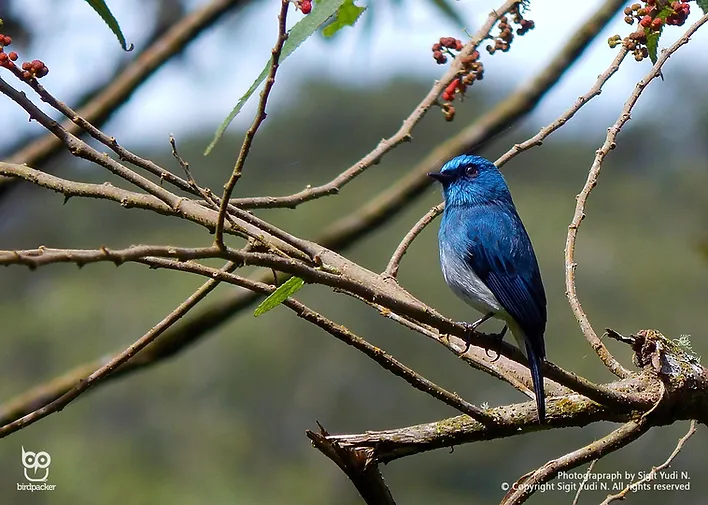
We waited until the birds perched near us. Definitely at 08.00 AM it perched in front of us for about 7 meters away. Then we shot it. Satisfied with Javan Kingfisher, then we must head to the airport. On the way we stopped for a while at Raden Soerjo GP Forestry for 30 minutes. Directly we saw and shot two individuals, Indigo FlycatcherEumyas indigo. The birds were foraging, after we got the photo of it, we continued to the airport and the bird photography trip in East Java ended.
On January 28th- February 04th 2017 about one week I had birding in Raden Soeryo GP Forestry. There are a few birding sites in the area that I have visited such as the hot spring “Cangar”, Watu Ondo Bridge, Gajah Mungkur, and Sendi.
Many birds are interesting and beautiful that I can see on these premises, especially in the hot spring “Cangar” and Watu Ondo Bridge. Compared to other places I have visited before, the birds in Raden Soeryo GP Forestry are much more easily found and approachable.
While I was drinking and eating fried foods, the birds would come by themselves around the stall near the hot spring. Javan FlamebackChrysocolaptes strictus, Grey-headed CanaryFlycatcherCulicicapa ceylonensis, White-crowned ForktailEnicurus leschenaulti, Little Pied FlycatcherFicedula westermanni, Indigo FlycatcherEumyas indigo and other birds, often small insect foraging on trees near stall.
However, out of all of the birds, Indigo Flycatcher (Eumyas indigo indigo) is one bird that caught my attention. When I was eating “Sempol” (typical food of this place) on the edge of the road bridge Watu Ondo, four individuals of Indigo Flycatcher approached me.
Two birds were perched close together on Casuarina junghuhniana. The distance of approximately two meters away from where I was standing was very obvious and very beautiful. And the shiny metallic blue when exposed to sunlight.
The two birds were chirping softly, a very beautiful done repeatedly. When one individual chirps, other individuals will replay with a chirp while slightly bowed head. This behavior is observed for about five minutes, before the birds fly away.
The two birds are male and female which will perform the courtship display of its preliminary breeding cycle. It is based on breeding information of Indigo Flycatcher that are known in February-August and December.
Indigo Flycatcher found only in Montane and submontane primary and moss forests, from 900 m to 3000 m; generally less frequent above 2600 m. of Java island, Indonesia.Beautiful moment I have rarely encountered before. A perfect birding and delicious food!
A total of 5 species of birds in Raden Soerjo Greater Park Forestry successfully photographed by our guest named Muhid on 22 July 2017 in just about 1.5 hours. In one day we had to change location 3 times. The first is the apple plantation area in Batu. There we entered into birdhide starting at 05.30 am to photograph Javan KingfisherHalcyon cyanoventris.
Our birdhide lies parallel to the tree with a distance of 8 meters, very enough for the 500mm lens to get full frame images. It did not take long for a Javan Kingfisher Halcyon cyanoventris to land at the top of an apple tree in front of us. Quickly our guests photographed the bird and got a picture of Javan Kingfisher’s front body. About 5 minutes later, the bird flies from the apple tree.
The morning weather conditions were less friendly, because the sun was covered by fog. So the birds, especially the Javan Kingfisher which became our target, were too lazy to perch and sunbathe. Until 07.30 am the target has not been seen again, we finally have to move to Raden Soerjo Greater Park Forestry. Arrive at the location at 08.00 am.
We went straight to Sunda Warbler’sSeicercus grammiceps nest in the feeding phase. We take a distance of about 8 meters, so as not to disturb the adult to feed the chicks who has not been out of the nest. A pair of adult birds are seen alternating in and out of the nest and catching insects near the nest to give to the chicks who are waiting for the food.
Young-Indigo-FlycatcherSunda-Warbler
It did not take a long time to get a photo of this bird. When an adult bird carrying food is brought to the nest, it will surely be near the nest long enough while looking around. That moment is a good time to take pictures. Suddenly the flocks of Sunda MinivetPericrocotus miniatus and Blue NuthatchSitta azurea perched on a tree near the entrance of the location. We guide guests to the place. Easily these two species can be recorded by our guests.
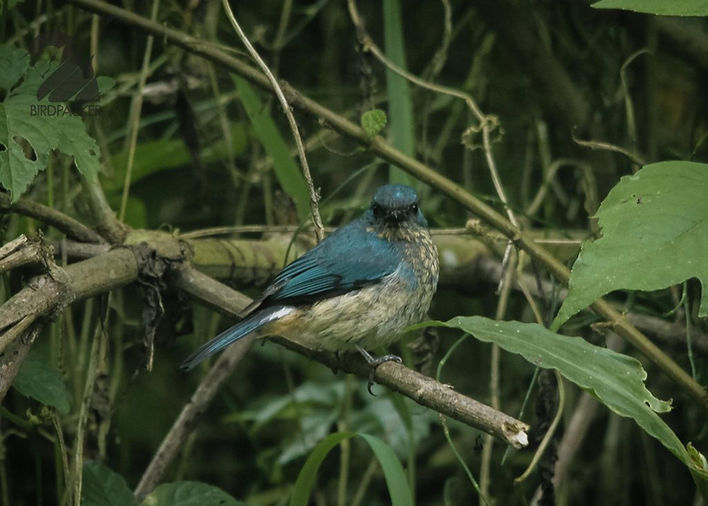
After the flock was gone, we proceeded to the parking lot. Immediately we met two young Indigo FlycatcherEumyas indigo individuals. The bird perched on a bush about 30 cm above ground level.
The two young individuals moved from one branch to another branch near the parking lot. 10 minutes later we saw an adult individual perched on a pine tree on a twig as high as 6-7 meters from the ground. We enjoyed the behavior of all three Indigo Flycatchers up to Lesser Forktail Enicurus velatus coming near us. The endemic bird landed on the ground to look for the insects behind the leaf litter.
After getting some photo frames, the bird goes to the small river on the opposite side. A brief bird-photography trip at Raden Soerjo Greater Park Forestry finished.
One of the best locations for birding in Malang area, especially to see Javas montane endemic birds is at Raden Soerjo Greater Park Forestry. Read more about the location here. This location is also listed in The 100 Best Bird Watching Sites in Southeast Asia. In July this weather in Malang, Batu and surrounding areas is great for birding, mostly sunny from morning to afternoon. Only occasionally 1-2 times there is a small and short rain in a week. Similarly, on Monday, July 17, 2017 at one birding site Raden Soerjo Greater Park Forestry named Watu Ondo.
The sun was shining brightly when we were arrived around 08.00 AM. We were greeted by 2 Indigo Flycatchers families who were nurturing their already flying chick. The immature have chest and throat spots red-pink, brown-red slices, black beak and legs.
This is surprisingly make us happy after the #Savebirdnest project several months ago and still running. After a while there was a Javan Hawk-eagle soaring above the parking area, followed by a Crested Serpent-eagle whistle then appearing above us. The presence of the two species of eagle indicates our arrival at the site late to see various types of birds, because the birds must have gone to find food. Moving ahead of the regional ticket sales counter, there was the sound of many bird species. There’s a herd of Crescent-chested Babbler and Horsfield’s Babbler on the jungle floor, then on the canopy a family of Snowy-browed Flycatchers is watching the immature descend on the pavement of the highway. Immature spotted birds brown, sliced dark brown, black beak, legs gray to brown. In the upper canopy are two species of endemic birds, a pair of Chestnut-fronted Shrike-Babbler and the Sunda Streaked Bulbul flocks that are eating the remains of fruits and insects in the leaf armpits. After the flocks of the birds disappear, return to the parking lot again. Suddenly a Lesser (Sunda) Forktail flies and lands on the ground. This bird is feeding behind the dried leaves that are around the parking lot. Not so difficult to observe and photograph this bird, just walk slowly and squat to the desired distance.
Lesser (Sunda) Forktail that is observed is male birds because it has a crown and nape of gray to black. Around the area there was Pygmy Wren-Babbler’s voice behind the thick grass. I waited a little longer but the bird did not come up with the form.
At 10:00 AM the area became deserted from the sound of birds, so we headed to the food stalls and waited for the birds to reappear. While waiting for me to try along the creek beside the stall, walk about 100 meters and then a Fulvous-breasted Woodpecker alighted on a small branch of a tree beside the river. When I take the camera that I leave at the food stall, the bird actually disappears. I went back to the food stall.
Until 11:00 AM the condition was still quiet, we were only entertained with a group of Ebony Leaf Monkey who eat young leaves in the trees around the stall. It’s easy to meet and observe Ebony Leaf Monkey around the Raden Soerjo Greater Park Forestry which is Vulnerable status according to IUCN Redlist and only exists in Indonesia.
We decided to go home when the fog began to rise and it would be difficult to photograph the birds in that situation. Back to the parking area we were greeted by a Flame-fronted Barbet who was eating. We try to get close and look at it. We are trying to take pictures but the light is not good and the fog is annoying to get good results. Finally we just took a record shot and went home.
The results are not so disappointing because we get 11 species of birds, and 5 species are endemic birds within a short time.
I had the opportunity to visit Raden Soerjo Greater Park Forestry, Malang. The area is a mountainous forest on the slopes of Arjuno-Welirang-Anjasmoro mountains. This place is one of the best locations to birding/bird watching and bird photography typical Javan mountain birds I have ever visited. There are two birding sites I’ve visited, Watu Ondo waterfall and hot spring baths Cangar. Visiting this place always makes eyes amazed with the beauty of the landscape and the colorful birds hopping among the leaves.
This second chance to visit the area, I was accompanied by a courtier of Birdpacker, Waskito Kukuh Wibowo, Nurdin Setio Budi, Swiss Winnasis, Ahmad Yanuar, Arif Budiawan and M. Hilmi. Thanks are the highest and lift the cap for those who have guided observation wholeheartedly. For nearly a week of observation, 31 species can be observed very well. Of the 31 species observed, I’ll tell you the highlights from day to day.
Day 1, Monday, December 19, 2016
I arrived at the Watu Ondo waterfall at noon, too bad. Fortunately, my observations at the very special place. Though it was daylight, there were still a lot of birds that could be enjoyed. Flame-fronted Barbet is one bird that is very easily found and photographed on the first day. A kind tree from the family piperacea that was bearing fruit became its favorite food and we can find these birds easily very closely. This bird is one of the endemic birds of Java with the dominant color green, very pretty.
Flocks of Sunda Minivet break my focus while observing and photographing barbets. Dominant orange contrasting strongly with green leaves around, makes it such a beautiful flower that broke-fracturing. This bird is endemic to the highlands of Sumatra and Java, very easy to seen in this place.
Later I was invited to the site, not far from the parking lot Watu Ondo waterfall and its location is easy to reach. After waiting a while, finally a Javan Hawk-eagle appeared and perched on a tall tree. I tried to take pictures with a 400mm lens, but it was still very far to reach.
Not long from the first encounter with the Javan Hawk-eagle, it persistently reappeared. This time perched lower than before. Even had flown right over our heads. Even had flown right over our heads. Finally I succeeded in photographing Javan Hawk-eagles from a short distance. Yeay!
On the first day I was also guided to observe the Mountain Leaftoiler’s nest. The Nests laid on top of the plant that are not too high. Several times the birds were seen carrying food into the nest. Most likely the eggs had already hatched a few days ago and now in parenting by both parents. I succeed in shots when the birds return to the nest.
Day 2, Tuesday, December 20, 2016
I was very lucky because the next night I stayed in the area, so I could birdwatch and photograph birds earlier than before. Luckily the weather was quite bright despite the night it rained. Some birds appear gathered in the courtyard of the pavilion which is filled with grass. Interestingly, among the flocks, there are several Common Myna. Its population in several places in Indonesia is the result of the introduction, mainly from domestic birds loose. Distribution of Common Myna is actually in Afghanistan to Western China, Southeast Asia and the Malay Peninsula.
After breakfast, I continue the observations in the park around the hot spring Cangar. Several kinds of small to medium sized birds such as the Little-pied Flycatcher, Indigo Flycatcher, Blue Nuthatch, Ruddy Cuckoo-dove can be easily found here. Even photographing Ashy Drongo that can be found in the tree behind the public toilet of this hot spring. Similarly, along the small stream close to the hot spring, it could meet with Grey Wagtail and Lesser (Sunda) Forktail.
From the park area I continue observations to the jogging track. Footpath through the woods located behind the hot spring Cangar. The sounds of Lesser Shortwing very loud along the way. However, to observe and photograph it took extra patiences. Besides small size, agile movements, and the color of the body is brown perfect for camouflage in the thick bush.
There are also birds that hide in the bush, but more easily observed and photographed on this path, b. Small-sized brown with white eyebrows can be found easily along the jogging track. The bushes along the track have become a favorite location for hunting small insects or spiders.
Day 3, Wednesday, December 21, 2016
I was accompanied by Waskito and Nurdin to birding in Watu Ondo waterfall. The three main targets are the Pink-headed Fruitdove, Lesser (Sunda) Forktail, and Lesser Shortwing. For the first target, I headed to a large tree that bears fruit. Waskito and Nurdin said that the tree is visited by a Pink-headed Fruitdove every day. A Pair of Pink-headed Fruitdoves foraging on that tree which the fruits are drying up. Endemic birds to Sumatra and Java, seen very pretty with a head purple and green dominate the body. Flame-fronted Barbet also foraging at the same tree. Combo!
The second target is easier than before. The location right behind the canteen, a small river crossing on the edge of the canteen is a good habitat for Lesser (Sunda) Forktail. We can wait for the birds to arrive while enjoying coffee or tea in the canteen. Camouflage tent did not need to be photographed. We can use the canteen kitchen as a safe place to observing or photograph the birds.
As we were chatting and drinking tea in the canteen, a Pied-Shrike Babbler perched on one of the trees near the canteen. This bird was seen eating a caterpillar. Likewise at the same time, the group of small birds such as Javan Grey-throated White-eye, Blue Nuthatch, Sunda Bulbul, and Sunda Minivet arrive. I get confused about which one should be photographed first.
Although I already saw Lesser Shortwing on the second day, to photograph these birds needs extra effort, patience and being smart. Waskito and Nurdin guide me to photograph Lesser Shortwing in the nest. Incidentally they’ve been monitoring the nest for a few days. I was lucky to have been guided by them. However, I am only able to photograph these birds while in the nest. I succeeded in getting a few frames before the birds left the nest for food. I was also able to photograph Sunda Warbler.
Day 4, Thursday, December 22, 2016
There are two kinds of birds being targeted on the fourth day, Orange-spotted and Sunda Bulbuls. Although both are easy to find, for 4 days of observation I have not gotten a chance to photograph it from an ideal distance. To fulfill this desire we return to Watu Ondo waterfall.
Shortly after enjoying a coffee in the cafeteria, I heard the sound of Orange-spotted Bulbul and moved to the trees near the parking area, where the birds were singing. Several Orange-spotted-Bulbuls were eating the fruits from that Piperacea’s tree. Finally, I managed to get several frames of these endemic birds.
Next we move towards the bridge Watu Ondo, not far from the waterfall to photograph the Sunda Bulbul. Soon, targets were found. Several Sunda Bulbuls were eating the fruit that was right near the bridge. They were not sensitive to the presence of us who were close enough around less than 10 m from where the bird was eating. Just like the previous target, I succeed to get a photo of Sunda Bulbul.
Flame-fronted BarbetLittle-pied FlycatcherMountain Leaftoiler on the nestSunda BulbulMale Sunda MinivetPied Shrike-babblerAshy Drongo
Raden Soerjo Greater Park Forestry is one of the remaining natural montane-forest in Java. Located in the west-slope of mount Arjuno-Welirang-Anjasmoro (3,339 m asl), has a total area of 27868.30 hectares and has a special place for birding.
This area is a mountainous plateau that stretches from the North-South. A bumpy topography of the region and mountainous with an altitude of 1000-3339 m asl. Slope level reaches 30-90% with annual rainfall ranging between 2500-4500 mm. Temperatures at night ranged from 5-10°C. Whereas in the dry season can reach 4°C. The humidity is quite high, ranging from 42-45% (lowest) to 90-97% (the highest).