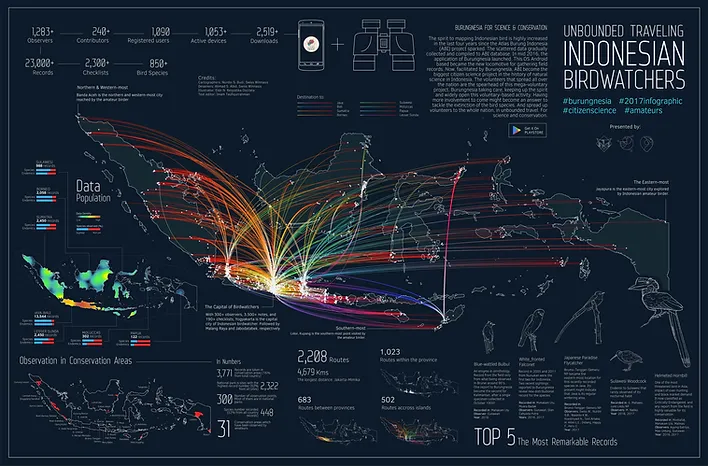
Android OS based app Burungnesia was already 1.5 years old at the end of 2017. Burungnesia was designed as a digital field observation tool. It collects records from bird watchers throughout Indonesia.
At least it holds more than 23,000+ records with 2,300+ observation locations. Interestingly, 850 more species have been recorded, at least that number already represents half of existing bird species in Indonesia. This is a shared dream since 2013 ago from Indonesian birdwatchers, answering how scattered observation data can be collected into one.
A colossal dream of the amateurs for birds, now, tomorrow and forever. A mega-voluntary project that is funded by pure love beyond anything. An endless amateur work. The highest appreciation for all Indonesian birdwatchers !!!
Sumbawa island is part of the lesser sunda area, it’s located between Lombok, Flores and Sumba islands. In terms of birding activities, this island is often missed or skipped by most birders. Fortunately there are some local birders who are avid enough to explore and document the existence and diversity of birds. Surprisingly, almost all the endemic species are relatively easy to photograph, which was suitable for bird photography tours on Sumbawa island.
For six days (09 – 14 November 2017) we were in Bima, Sumbawa, West Nusa Tenggara. Precisely in TWA Madapangga to attend the Pertemuan Pengamat Burung Indonesia VII (Indonesian Bird Watchers’ Meeting VII) on 10-12 November 2017 and extended two days to focus on birding in other locations.
At the meeting there were birdwatchers from Jakarta, Bandung, Yogyakarta, Malang, Bali, Lombok and from local birdwatchers of Bima. The Sindikat Fotografer Wildlife Bima-Dompu was the organizer and host of the meeting.
TWA Madapangga is located in the west of Bima city with a distance of about 45 Km or takes about 1 hour drive by car. The area of 232 Hectares is administratively in the village of Ndano, Bolo sub-district, Bima district, West Nusa Tenggara Province.
This nature park is a source of water for the dryness of the surrounding area. Residents around the area are very dependent on the river and its springs. In the morning and evening I could meet with residents who bathe or wash clothes in the river that is located exactly on the road which connects Bima with Sumbawa city. The topography of this location is generally hilly with a slope of 15 – 40 degrees, only a small part is a relatively flat area with varying heights from 200 to 600 m above sea level.
Birding spots are relatively easy to reach, such as following the loop-track of the camping ground, around the river, and garden of the pool. We tried all those spots while we were there.
After the meeting, we moved to Kaowa village, Lambitu sub-district, 2 hours heading to the east of central Bima city. In this hilly village is widely used as a garden or farm area by residents with the rest of the monsoon forest on each hilltop. Birding spots are located around the village water springs and the edge of forests after farm areas close enough to residents’ houses.
PARTICIPANTS:
Swiss Winasis, Waskito K Wibowo, Ah Saiful Abid, Imam Taufiqurrahman, Alkharim Yoshe, Afran “Tpal Duablas”, Abdul “Gizan Hila” Azis. ITINERARY:09/11/2017 – At the evening arrived in Airport and drive to TWA Madapangga. Overnight on the tents. 10/11/2017 – Morning birding until noon. Lunch and follow the meeting until 09.00 PM. Owling for one hour. Overnight on the tents. 11/11/2017 – same as above12/11/2017 – Morning birding until noon. After lunch moved to Kaowa village. Arrived at 06.00 PM then dinner with local families. Owling until 10.00 PM. Overnight in local families. 13/11/2017 – Full day birding around the edge of forest and water spring. After dinner owling around water spring again until 10.00 PM. Overnight in local families. 14/11/2017 – Drive to the airport, birding on the way. At noon we flight home and birding trips in Bima, Sumbawa island was ends.
HIGHLIGHTS:Glittering or White-rumped Kingfisher – 2-3 birds seen at looping track at the TWA Madapangga. 2-3 birds seen at garden and around water spring of Kaowa village.
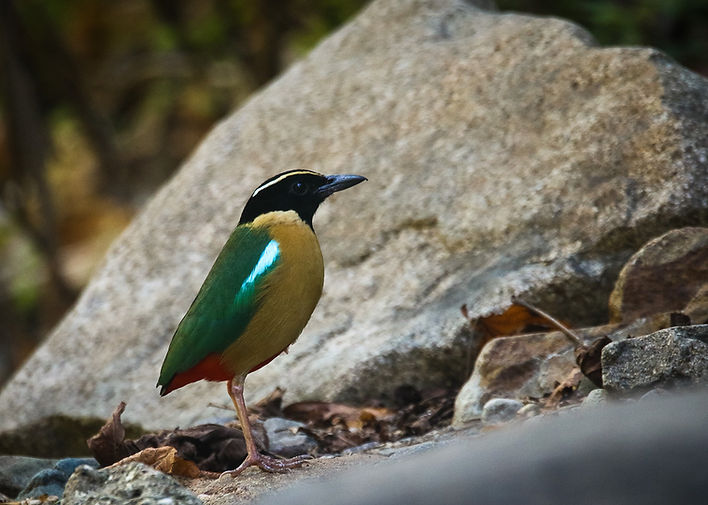
Elegant Pitta – 5-6 birds seen behind the camping ground and edge river of TWA Madapangga. 2 birds seen at water spring of Kaowa village. Relatively vocal during our visit.
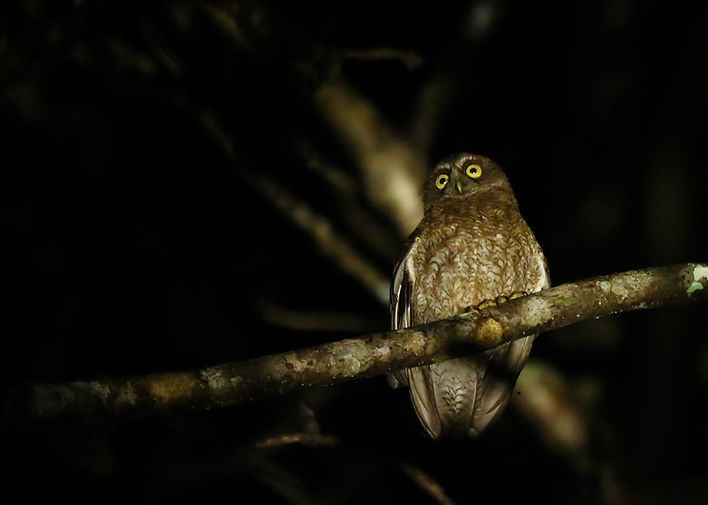
Flores Hawk-eagle – A clear view of a single bird while perched near the road at the edge of Kaowa village. Mollucan Scops-owl – 30 minutes clear view of single perched bird behind the camping area of TWA Madapangga. 3 birds (two adult and one juvenile) seen at water spring of Kaowa village. Wallacean (Flores) Drongo – Two nest about 6-8 birds seen around the pool of TWA Madapangga. Two nests are also around the garden and water spring of Kaowa village. Flame-breasted Sunbird – Male and female birds at flowering Water rose apple tree around the pool of TWA Madapangga. 2 birds at garden of Kaowa village. Black-fronted Flowerpecker – 2 birds seen near river at fruiting tree’s TWA Madapangga. Yellow-spectacled White-eye – Common in all birding spots visited. Flores Minivet – A pair on the way to the Airport from Kaowa village. Brown-capped Fantail – Single bird at loop trek’s TWA Madapangga.
Other notable birds included – Spotted Dove, Barred Dove, Cave Swiftlet, Lesser Coucal, Black-winged Kite, Oriental Honey-buzzard, Short-toed Snake-eagle, Oriental Dwarf-kingfisher, Common Kingfisher, Collared Kingfisher, Sunda Pygmy Woodpecker, Spotted Kestrel, Scaly-crowned Honeyeater, Helmeted Friarbird, Black-naped Oriole, Rusty-breasted Whistler, White-shouldered Triller, White-breasted Woodswallow, Black-naped Monarch, House Swallow, Sooty-headed Bulbul, Brown-throated Sunbird, Scaly-breasted Munia, Eurasian Tree Sparrow.
Birding in Wonorejo wetland, located at the Surabaya south east-coast, with a total area of approximately 50 hectares and consists of fishpond (locally called tambak), scrub and mangrove areas affected by tidal, provides a broad mudflat for feeding grounds to resident and migratory birds in estuary area. This site is important for migratory seabirds and shorebirds/waders in East Asia-Australia Fly Away, also birdlife listed Wonorejo as Important Bird Area.
Administratively in Wonorejo village, Rungkut sub district, Surabaya City, East Java. The area became the best locations for birding and bird photography in the Metropolitan Surabaya. Easy driving distance for 15 km from city centre (45 minutes). The nearest airport is Juanda International Airport (45 minutes).
Three major paths or spot to explore approximately 150 birds species in the area, read below:
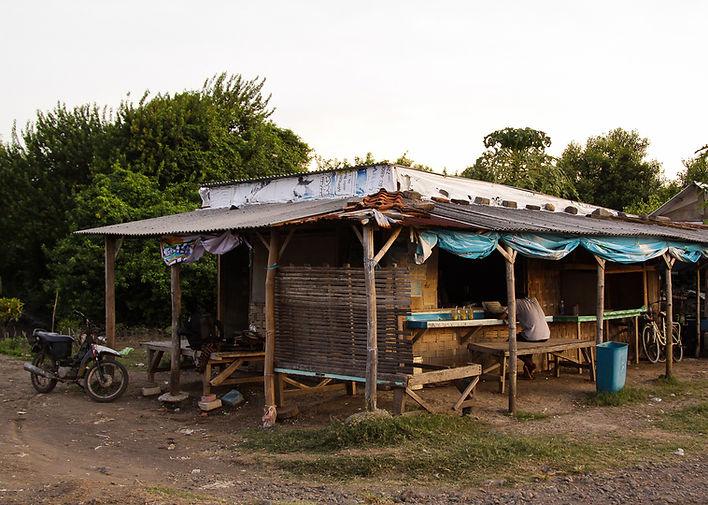
1. Parking Area (Near Canteen “Mbok Rum”)
Start from around the parking area, walk and observe some birds may you see here are Collared Kingfisher, Cattle Egret, Little Egret, White-browed Crake, Common Moorhen, Plain Prinia, Yellow-bellied Prinia, Brown-throated Sunbirds.
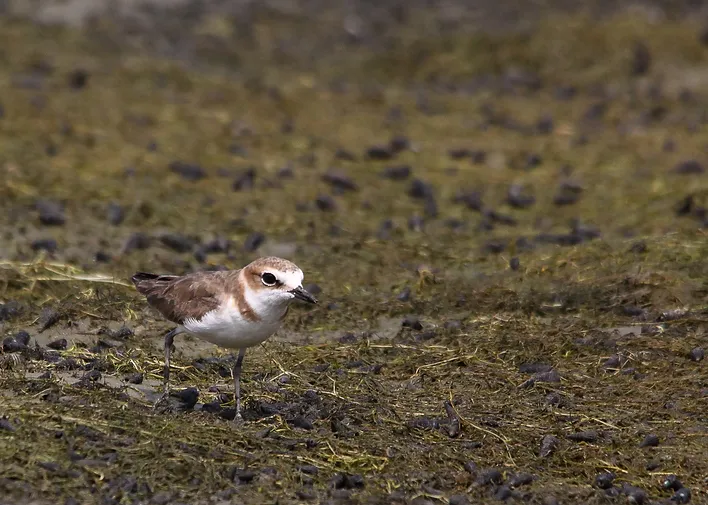
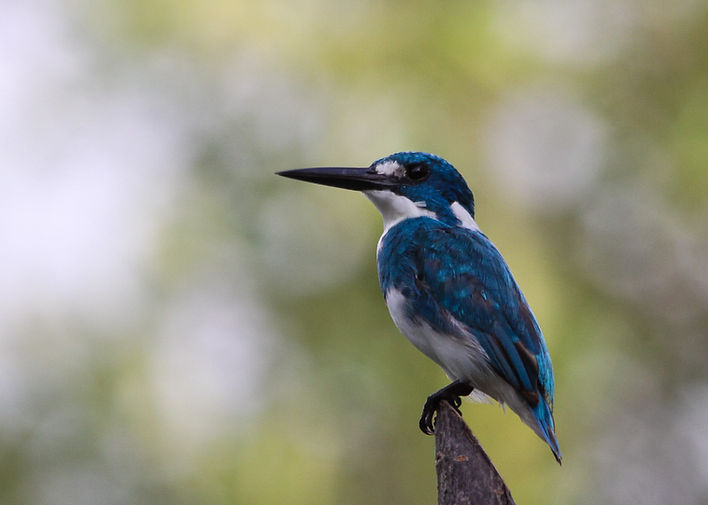
Some endemic birds such as Scarlet-headed Flowerpecker, Small-blue or Cerulean Kingfisher, Javan Munia and Javan Plover. And during the migration season of the North Hemisphere, various migratory birds might be seen such as Red-necked Stint, Curlew Sandpiper, Long-toed Stint, Common Sandpiper, Greater Sand Plover, Lesser Sand Plover and more.
2. Fish Pond
From the parking area walk to the east towards the fishpond area. Along the paths the birds might can be seen are White-headed (pied) Stilt, Lesser Crested Tern, White-winged Tern, Little Tern, Common Tern, Gull-billed Tern, Australian Grebe, Little Cormorant, Spotted Dove, Common Iora, Javan Pond Heron. If lucky, some endemic and rare birds such as Javan Coucal and Java Sparrow. There are several fishponds where the specific shorebirds prefer presents such as Bar-tailed Godwit, Great Knot, Whimbrel, Far-eastern Curlew, Eurasian Curlew, Common Redshank, and more.
3. Mangrove track and Estuary
Continue walk in the east direction to explore the last birding-site, at mangrove track. Hang and walk around the mangrove until 5pm to meet Golden-bellied Gerygone, Racket-tailed Treepie, Malaysian Pied Fantail, Mangrove Whistler, Ruddy-breasted Crake, Cinnamon Bittern, Yellow Bittern, Striated Heron. With some luck the endemic Javan White-eye might be able to be seen, recently the species is hard to find because of massive poaching.
Access and Accomodation Many good quality hotels around Surabaya city and ask the receptionist to arrange a taxi or ojek to get to Wonorejo wetland. If you are confused to determine the birding spot, ask local guides to accompany you in the field.
Notes: We advise you to write down in the Guest Book and add some extra money for conservation donation at Canteen “Mbok Rum”. Take a scope, sun tan lotion and hat to get the most out of the site!
A sunny day when we were birding in Tahura R. Soeryo, Malang, East Java on 21 October 2017 with a family group from Jakarta. I Departed from Batu city around 08.30 am and arrived at the first location around Cangar hot spring 09.30 am.
We started walking around the cafeteria, we were greeted by Gray Wagtail flying down a small river in front of the canteen. Then scoped at the branches of the trees around. For 10 minutes only Sooty-headed Bulbul appeared.
Moved around the public toilet immediately greeted a Javan Kingfisher perched on the tree behind the toilet. We approached and looked for a clear view to enjoy its colorful feathers. These Java-Bali endemics are usually not easy to observe, it would fly away when seen by people approached.
Then the mix-flocks come with a noisy tweet at the top of the trees near the hot spring garden. The observed species such as Black-winged Flycatchershrike, Sunda Minivet, Sunda Cuckooshrike, Ashy Drongo, Blue Nuthatch and Velvet-fronted Nuthatch.
Next, we went into a jogging trek that led to the Japanese cave. Quite quiet along this path, just heard Rusty-breasted Cuckoo singing and a fast view of Oriental Cuckoo. Likewise when we arrived in front of the Japanese cave, hardly any birds appeared.
Wait a while and at least see the female White-flanked Sunbird and Javan Whistling Thrush which was the island’s endemic. Around 11.30 am I moved to the second spot, Watu Ondo ‘s parking area and park.
SeriousGroup Photo
Upon arrival, an Indigo Flycatcher welcomed us.Indigo subspecies became full species spread only in montane and submontane primary and moss forests of Java. He perched on the bushes and occasionally grabbed the flying insects around it.
The raptor migration had begun, marked by the presence of Crested Honey Buzzard soaring high enough above us, then flew away from view.
We then walked in the opposite direction and found some Flame-fronted Barbet foraged at Ficus sp trees. This bird was very tame and did not care about us observing it close enough, about 10 meters.
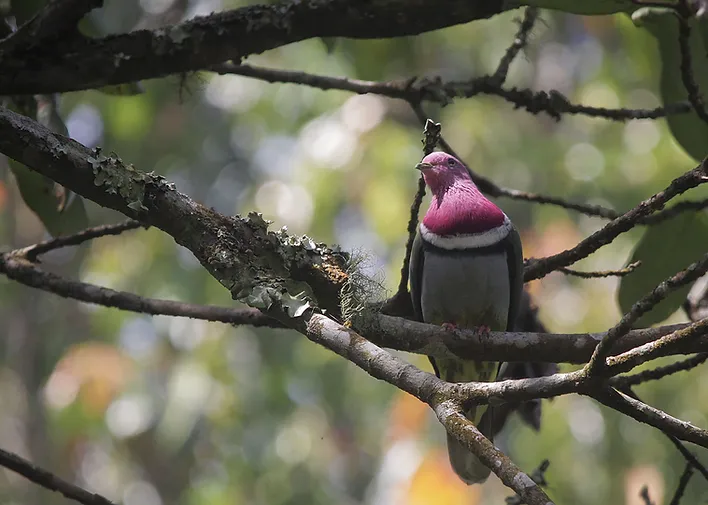
Suddenly in the same tree from behind the leaves came a Pink-headed Fruit-dove to the center of a twig near the main stem. The red color in the head to his chest very firmly indicates that this was a male bird.
Same with the previous species, he did not feel disturbed by our presence. For approximately 45 minutes, we enjoyed this beautiful bird. Sometimes he ate the fruit of Ficus sp and then moved to perched and returned to eat the fruit. This live in the mountain forests of Sumatra and Java, became tour closing. Although it was only one day, at least we were lucky to see many species that were quite elusive and of course beautiful.
Systematic List:
1. Sooty-headed Bulbul | Pycnonotus aurigaster
2. Grey Wagtail | Motacilla cinerea
3. Lesser Forktail | Enicurus velatus | Heard Only
On 14-15th October 2017 we received an invitation from Seabirds Indonesia (Burung Laut Indonesia) to perform seabirds surveys and monitoring especially to one of the most threatened seabirds in the world that listed on IUCN as critically endangered, the Cristmas Island Frigatebird around Jakarta Bay and marine area of the Kepulauan Seribu National Park, Jakarta.
This big pelagic bird with dominant feather colored black and white is an endemic island of Christmas, a small oceanic island governed by Australia in the eastern Indian Ocean, about 360 km south of Java, Indonesia. Using marine areas in Indonesia especially around Jakarta Bay for forage while breeding with Juvenile which will stay until mature and ready to return for breeding. The highest numbers ever known about Christmas Island Frigatebird are 209 individuals in this location from a total population of about 2400-4800. The numbers were not small considering the threat around Jakarta Bay, among others: Entanglement in fishing gear, Capture and attachment of string to leg, Poisoning / Sedating, and Shooting.
Team on boatScopingIdentifyInterview
We calculate the age of each individual Christmas Island Frigatebird and look for potential threats in Jakarta Bay and Kepulauan Seribu. In addition to Christmas Island Frigatebird, we also recorded the species of seabirds that use the marine area of Jakarta Bay and Kepulauan Seribu for forage or roosting during the migration season.
In addition, we also conducted a special interview with the head of a group of fishermen on the Harapan island.
Departing from Tanjung Pakis, Tangerang, Banten at around 08.00 am we sailed to sero (Traditional fishing) about 45 minutes. At the sero bamboo stakes that seabirds use for perch, we also counted seabirds passing by and flying around the fishing boats.
We had encountered such as Christmas Island Frigatebird, Great Frigatebird, Lesser Frigatebird, Little Black Cormorant, Greater Crested Tern, Lesser Crested Tern, Common Tern, Black Naped Tern, Brown Noddy, Oriental Darter, Glossy Ibis, Swinhoe’s Storm-petrel.
Flocks of FrigatebirdFishermen and FrigatebirdsLesser FrigatebirdAdult female Christmas FrigatebirdSurfing on SandalPerchedAloneClose upFlightMirroringAnother surfing bird3rdAdult male Christmas Frigatebird perchedPerchedDucks?Hiding on leaveFlock Terns in FlightOne by oneCrowd flockFlockgroup of Common TernAt about 01:00 pm we started to go to Harapan island overnight and met with fishermen to find information about the threat of seabirds.
At 03.30pm we arrived at Harapan island, then headed to the Kepulauan Seribu NP office and met staff and fishermen. 04.30 pm with local staff and fishermen we did afternoon birding around the shoreline of Harapan island. The birds that can be encountered such as: Slender-billed Crow, Pacific Reef Egret, Eurasian Whimbrel, Barn Swallow and Collared Kingfisher.
In the evening we discussed with the head of the fishermen group of Harapan island. Apparently most of the fishermen in Harapan island already understand the role and importance of seabirds, mainly helping them in finding fish locations. According to them, seabirds accidentally enter their fish nets. From the statement we ask to immediately release if in the future there are seabirds who accidentally enter into the net or fish trap.
15 October 2017 at 09.00 am we left for Tanjung Pakis while recording and counted the seabirds along the way. No new species were found. Around 02.00 pm we arrived at Tanjung Pakis and the activity in this month is over. Will be done again per month until December 2017.
Sumba is part of East Nusa Tenggara, famous for its megalithic traditions, one of which is Pasola. On this island, grassland and monsoon forest are still well preserved place for various animal species. Approximately ± 200 species of birds, ± 110 species of butterflies, ± 35 species of herpetofauna and ± 23 species of mammals. In particular, Sumba island has 36 endemic species and about 14 species of islands endemic.
For birdwatchers, Lewa, Yumbu-bridge and Manurara are mandatory locations to seek endemics. In August 2017 we found a new birding site in Sumba island. In the area of the only national park on the island, named Billa. This location is better than Lewa, especially for bird-photography. Almost all endemic species are within a very close distance and can be accessed by foot. Yet, by far the best location to see Sumba Buttonquail, is the grassland around Yumbu.
The following information on the birding site in Sumba:
Billa, Praingkareha Resort
It is part of Manupeu Tana Daru and Laiwangi Wanggameti National Park, located in the southern part of the island. Administratively entered into District Tabundung East Sumba, Nusa Tenggara province. To get to Billa from Waingapu is about 4-5 hours (110 Km).
Almost all endemic species can be found (except for Sumba Buttonquail) without moving from one site to another. Paradise for bird-photographers especially in August – October when the river dries up until the remaining small pools.
All passerine like Spectacled Monarch, Sumba Brown Flycatcher, Sumba Jungle Flycatcher, Sumba Flycatcher, Orange-backed Thrush, Orange-footed Scrubfowl, Arafura Fantail, Oriental-dwarf Kingfisher, Paradise-flycatcher and Elegant Pitta Paradise will come for a drink, easy to taking a photo. On the edge of the river can be found Red-naped Fruitdove, Sumba Green Pigeon, Sumba Cicadabird.
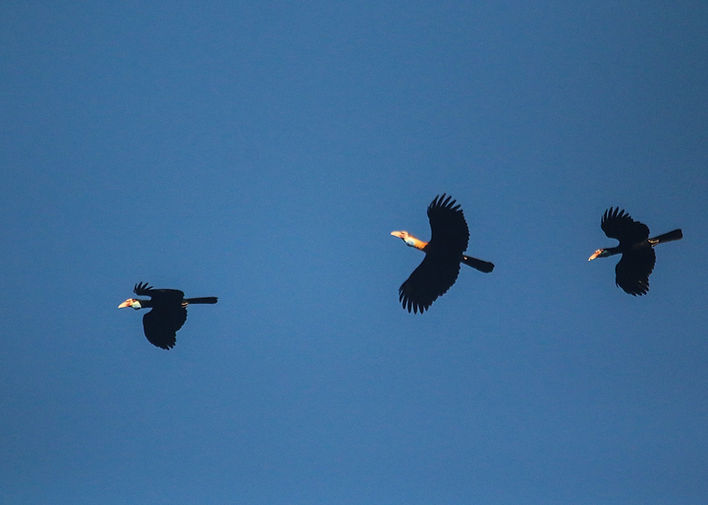
There is a hill called Laibola, about 30 minutes from the camping area to its peak. The best location in the morning to see Billa landscape along with the rising of the Sun, the birds will start actively looking for perch such as dozens of Sumba Hornbill before the breeding period, Yellow-crested Cockatoo, Electus Parrot, Red-cheeked Parrot, Great-billed Parrot and Marigold Lorikeet.
At night, just go to the public toilet Greater Sumba boobok will sound and be easily observed along with a dozen Least Sumba Boobooks and Meesi Nightjar.
Lewa
A village located in the middle of the island, still has a nice monsoon forest to see the endemics, accessible by driving from Waingapu (City center) about 1 hour 30 minutes (55 Km).
The main location consists of several sections along the connecting roads of West and East Sumba, among others: a patch of degraded forest east of Lewa at KM51 on the road, c10km west of Lewa at KM68-72; c20km south of Lewa near the village of Watumbela; and about 30km west of Lewa at KM93-98.
The birds might be can see Sumba Green Pigeon, Elegant Pitta, Chestnut-backed Thrush, Mees’s Nightjar, Orange-crested Cockatoo, Sumba Hornbill, Pale-headed Munia, Five-coloured Munia, Barn Owl, Greater Sumba Boobook, Little Sumba Boobook, Sumba-jungle Flycatcher, Sumba Flycatcher, Sumba-brown Flycatcher.
Yumbu Grassland
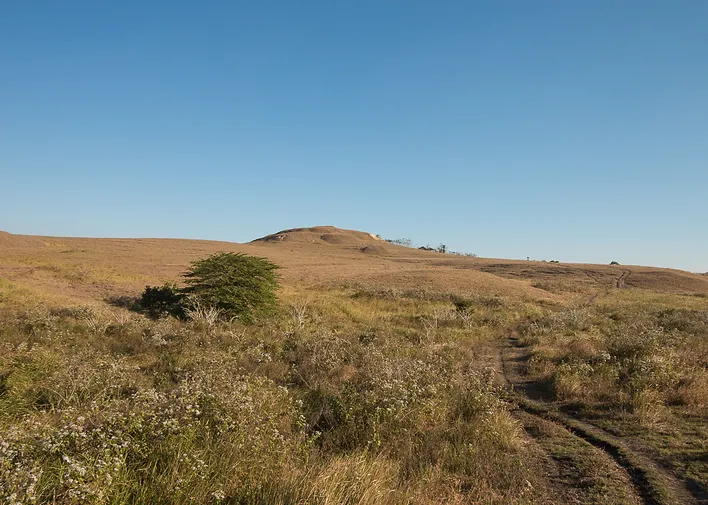
This site was commonly visited for Sumba Buttonquail. An area of open savannah like grassland east of town (12km from the airport). Aim for a road bridge at Yumbu. Walked the grasslands south east of the bridge, and also briefly north of the bridge.
The best way for you to get to all the locations in Sumba is by renting a car, because it makes it easier to reach each site. The trails can be a bit confusing so you may consider asking a local for assistance as a guide.
In Billa there are no hotels or homestays. Asking local people for stay at night or build a tent on a camping area (close with spring water and public toilet). Unlike Lewa and Yumbu, you can stay at night at Hotel in Waingapu and drive to the site in the early morning.
During 6 days (06 – 11 September 2017) we had a trip looking for three species of woodpeckers around Malang, East Java with Gerard Gorman (authors of Woodpecker of the World the complete guide). This was our first specific trip focused on a separated population of Freckle-breasted Woodpecker, Javan endemic Javan Flameback and Grey-and-Buff “Lilliput” Woodpecker.
On day one, we met at the Juanda International Airport (Surabaya, East Java) around 11.30 AM and headed to Wonorejo Wetland. After walking for 300 meters around the fish-pond we managed the first target, one group-family of Freckle-breasted Woodpeckers. We tried to observe the behavior.
At least we saw two families and managed to take photographs. After that, we changed direction to Malang for the hotel and managed for the rest of the targets.
In the next morning, we began observing at several sites of Tahura R. Soeryo for Javan Flameback. At 05.30 AM we tried to call the bird until one hour later we did not hear and see any responses. So we moved to the next site.
At Watu Ondo waterfall, we waited near a half dead tree. Unfortunately the birding was low, almost quiet. After lunch we moved to Cangar for the same target. The condition was the same as before until the next day. . We didn’t want to waste more time. We finished birding here and heading to Kondang Merak on that day.
Kondang Merak is located in southern Malang. Here is where the last of the natural lowland rain-forest of Malang still remains. In Kondang Merak, September 08, we will take a couple of nights at home-stay near the beach. Birding will start in the early morning around homestay. Grey-and-Buff Woodpecker and Javan Flameback are our main purposes here.
We must take a fast move, to play the bird calls was the best way to attract them to show up. Sadly we just saw a flash moment of the lilliput. This might be the birds on breeding periods so were not active with calls. We tried in other spots and gave the same poor result.
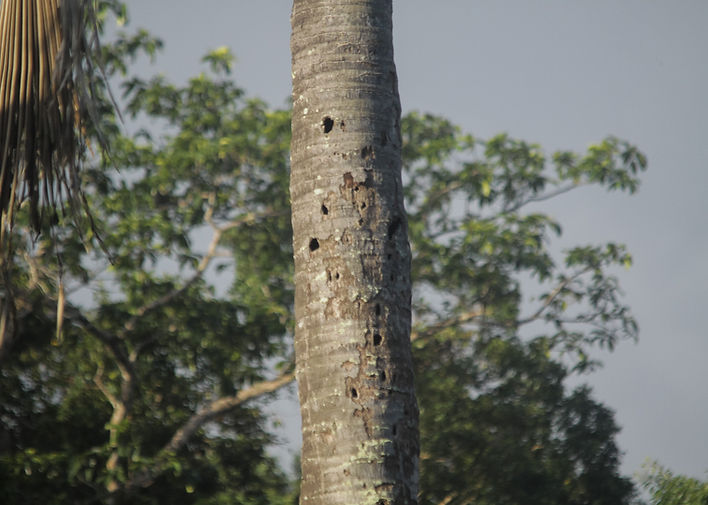
Until September 10 the birding was tough for us, in the afternoon we drove out to the border of the forest. We called Crimson-winged Woodpecker, and then Afwan saw a silhouette of a woodpecker on a dead palm tree. We were surprised that the woodpecker was a female Javan Flameback, and then the birds flew to another dead palm tree which had many holes.
At that moment we saw a female feeding the chick (Me and Afwan) and male perched on the top of the next dead palm tree. The female flew followed by male. We waited for four hours and they did not show up again. We went back to the home-stay and tried it the next morning.
At 05.00 AM we arrived at the same location as yesterday. While waiting, we played the call of Javan Flameback and Rufous Woodpecker. For a half hour the Javan Flameback finally showed up. A single Rufous Woodpecker came to the Ficus tree near us followed by two other ones.
We enjoyed the behavior, sometimes the birds reacted with the call by ‘drumming’. It’s quite difficult to get a photo because it was always hindered by the leaves. At 07.45 AM the birds flew one by one and left from our scope.
Although birding was low and tough, we finally managed to see four species of woodpeckers, three of which were targets. We drove for five hours to the hotel near Juanda international airport, the next day our Gerard will continue the search for woodpeckers in Sulawesi and Sumatra. Good Luck!
Additional: On September 17, 2017 I and a few friends revisited Kondang Merak to document the Javan Flameback in the nest tree. Arriving at around 03:15 PM we direct/heading to the nest tree. A few minutes later, no bird activity was observed. I initiated to approach the nest tree to ensure the existence of the bird. We clearly saw the nest-hole of the Javan Flameback. Most likely the young bird has fledged out. Next we headed to the home-stay for staying at night. The next morning we tried to find Gray-and-Buff Woodpecker and Javan Flameback around the home-stay and Jungle Trek.
From 6:30 to 9:00 AM our first trail failed to get the woodpeckers around the home-stay, then we moved to the jungle track. We walked and stopped at some point to play the calls and listen to the respond from the woodpecker. Until we reached the end of the jungle track we heard it was pecking. Soon we scoped the sound source.
Young and Adult Male Javan FlamebackYoung and Adult Javan FlamebackFemale Javan Flameback
Finally we managed to see three Javan Flameback (two males and one female) in one tree. The adults were taking care of the juvenile with a pale red crown. The group was most likely a different family from the other one. We saw their nest in the dead palm trees with a female juvenile.
Only Sumba ButtonquailTurnix everetti and Mees’s NightjarCaprimulgus meesi were not seen through our binoculars or lenses during the 9 days we were in Sumba. Sumba is an island in southern Indonesia, rich in various ikat weavings, vast grasslands, a strong ethnic culture and an endless list of interesting spectacles for tourists to enjoy. We came here looking for new birding spots to see the island’s endemic birds.
Depart from Juanda International Airport and transit briefly at Ngurah Rai International Airport and arrive at Umbu Mehang Kunda Airport, Waingapu, East Sumba Regency at 11:40 on 17 August. From 18 August to 22 August 2017 we attended the 2017 Birding and Photo Competition held by Manupeu Tana Daru & Laiwangi Wanggameti NP at Praingkareha resort in Billa Village, which was attended by about 55 participants from many regions in Indonesia. After the event was over, we stayed for the next 3 days and nights to watch and take documentation of the birds.
The day before the competition started, we went to Lambanapu village, 7 Km south of Waingapu for a short birding. We met with Pak Kornelis, a woven ikat craftsman who still practices in the traditional style using natural dyes. He kindly let us, with permission, go birding in his garden and rice fields, only 300 meters from his house.
His garden area contained many plants including Tamarind, Morinda, Kapok Randu, Indigo. We were accompanied by two teenagers, who acted as our guides. For nearly two years, the boys have been diligently documenting the local biodiversity including birds around the Village, so they are well aware of the birds that live there.
Around big Tamarind tree we observed Arafura Fantail, Broad-billed Flycatcher, Indonesian Honeyeater, Sumba Flowerpecker, Thick-billed Flowerpecker, Ashy-bellied White-eye and our main target Asian“Nusa Tenggara” Paradise-flycatcher. Around 15:00 we continued observations from the edge of the paddy fields that were filled with shrubs along the banks of the river. We saw Pale-headed Munia, Blue-tailed Bee-eater, Scaly-breasted Munia, Pied Bush-chat, Paddyfield Pipit, Brahminy Kite and at the end of the session a few flocks of “Timor” Zebra Finch.
That night we stayed at Waingapu then on the following day along with the participants, we left for Billa using local public transport called OTO. OTO is a truck modified in such a way as to transport humans, agricultural produce and even livestock!. It was an epic form of public transportation!
The trip from Waingapu to Billa (110 km to the south) took 4 hours , including about 1.5 hours of fine asphalt road, and numerous stops along the famous Wairinding hill, and several other interesting locations to enjoy views of the picturesque Sumba landscape. The rest of the journey (2.5 hours) was along an ugly 1980s asphalt road that wasn’t in good condition at all, making the ride very bumpy and uncomfortable.
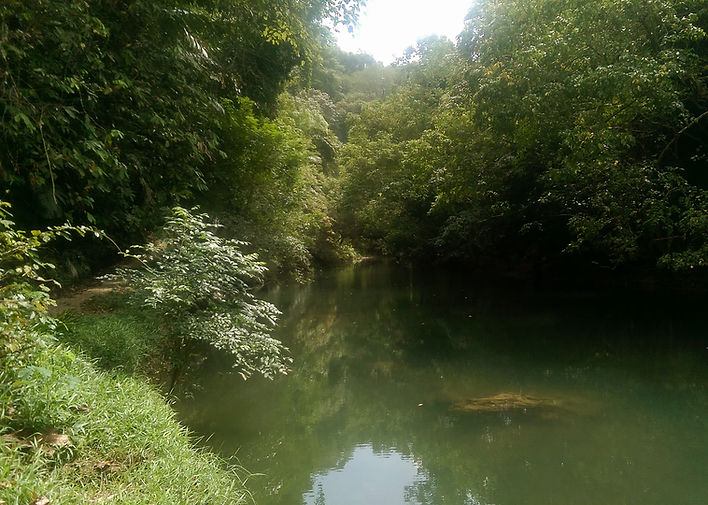
We finally arrived at Praingkareha resort, Billa Village at 15:00, and headed to a river that still runs as a small stream, with some puddles at the end of the dry season. Along the river various kinds of trees grow, the fallen leaves scattered on the rocky bottom, yet the water still flows over them.
During our stay (until 25 August 2017) the river was an ideal place to search for endemic and resident birds.
Birds that we met here such as:
Endemic Chestnut-backed Thrush , which can be found every day, sometimes perched on a branch above the river or looking for insects behind leaves and near puddles. Orange-footed Scrubfowl scavenged busily on the ground oblivious of us despite being in plain sight, from morning to afternoon. Mixed flocks of Spectacled Monarch, Arafura Fantail, Broad-billed Flycatcher often visit the river in the afternoon to bathe or drink. They all got very close to us , all the better to take photographs.
Sumba Brown Flycatcher, Sumba Flycatcher, Sumba Warbler (Jungle)-Flycatcher visited one by one, to perch on small branches and swoop down to catch their prey or simply wait silently on stones.
Sumba Flowerpecker were also seen eating tiny yellow fruits that grow on riverside plants. In the undergrowth, at least two individuals of Elegant Pitta were heard but trickier to catch a glimpse. Little Cuckoo-dove and Asian “Gray-capped” Emerald Dove would appear at the edges of the river to drink, and above female Pale-shouldered “Sumba” Cicadabird move from branch to branch.
We found a big dry tree that in the morning hosted many species such as Great-billed Parrot, Sumba Green-pigeon, Marigold Lorikeet, Green Imperial Pigeon, the endemic race of Yellow ‘Citron”-crested Cockatoo, Red-naped Fruit-dove and even Sumba Hornbill.
The smaller branches were observed being picked by Red-naped Fruit-dove for material to construct their nests.
We visited the Laibola hill on 20 August 2017 at around 06.00, from this location one we enjoyed a beautiful panorama of the landscape around Praingkareha resort. As the sun slowly rose the birds began actively seeking perches, and we managed to see several pairs of Electus Parrot, Red-cheeked Parrot, dozens of Slender-billed Crow and around 40 Sumba Hornbills.
Below the hill there is a forest patch, great for seeing Cinnamon Banded Kingfisher especially in the morning before 09:00 this bird can be easily located from their chirping, and seen perched quite low. From this vantage point, it is easy to find Sumba Myzomela, Apricot-breasted Sunbird, Wallacean Drongo, Ashy-bellied White-eye, Yellow-spectacled White-eye, Black-naped Fruit-dove, Helmeted Friarbird, Rusty-breasted Whistler, Short-tailed Starling. Along the forest patch we heard Elegant Pitta calling one to the other.
During our last three days in Billa, especially in the evening, we focused on finding two endemic species of boobooks. We found one only 400 meters from the camping ground, using playback techniques to discover a pair of Greater Sumba Boobook.
On the final night after observing the Greater Sumba Boobook, we searched for Little Sumba “Least” Boobook. After walking about 3 Km from the camping ground we stopped in a vast grassland, started calling, and scoped around the area. At the far end of grassland in the middle of a tree trunk, we finally saw one individual. We tried to get as close as we could and managed to get a photograph.
The bird flew into the forest so we had to follow it in, looking for the elusive critter. Surprisingly, we soon heard at least fours individuals, managing to get clear and short views better than before. At 23:30 we finished owling, and set off back to the camp.
On the last day prior to Waingapu, we returned to the river. We waited on the other side of the almost dry pool, when at 08:00 an Elegant Pitta, which is usually only heard, came down from behind a bush.
The gorgeous bird started flipping leaf litter with its bill while hopping to the nearest pool. We did not stop pressing the camera shutter while sitting as still as we could behind some rocks. Finally, the bird perched on the highest rock, and in that moment we were amazed at the blend of colour all over its body.
Although we were only in Sumba for 9 days, and only visited two locations we successfully managed to spot 19 endemic species, and 43 resident species, missing only Sumba Buttonquail and Mees’s Nightjar. Although, according to the park ranger, these Lesser Sunda endemics are also present on Billa.
We were amazed by Billa, a place to see almost all endemic Sumba by just sitting waiting by the river, or simply walking around the camp area. We called it One Stop Birding Site, the best place to photograph almost all the endemics! Hopefully we will go to Sumba again to complete the endemic list, and explore more, anyone want to join? Feel free to contact us via e-mail for information about the site and organising a tour.
Yellow-crested ‘Citron’ CockatooApricot-breasted Sunbird_Cinnyris buettikoferiMale Sumba HornbillA family of Black-faced Munia_Lonchura moluccaChestnut-backed Thrush_Geokichla dohertyiSumba FlycatcherCinnamon-banded KingfisherArafura Fantail_Rhipidura dryasYellow-spectacled White-eyeEclectus Parrot_Eclectus roratusElegant PittaMale Sumba MyzomelaMale Sumba FlowerpeckerSumba Jungle-flycatcherSpectacled MonarchPale-shouldered CicadabirdOriental Dwarf-kingfisherOrange-footed ScrubfowlMarigold LorikeetMale Nusa Tenggara Paradise-flycatcherLittle Cuckoo-doveJuvenile of Indonesian HoneyeaterHelmeted FriarbirdGrey-capped Emerald DoveGreat-billed ParrotFemale Female Sumba FlowerpeckerNusa Tenggara Paradise Flycatcher
We are so happy finishing our three days (30 July – 01 August 2017) bird photography trip in Tretes Nature Tourism Park , Raden Soerjo GP Forestry and Batu Apple Farm with a Chinese group that series of Bird Photography tour Surabaya-Makassar-West Papua.
In this delightful trip cooperated with Sulawesi Bird and Wildlife Photography Tour and Malang Birding Tour.
The main target birds are Javan Banded PittaPitta guajana and Javan KingfisherHalcyon cyanoventris, also the other that we might find on the site.
Meeting point in the International Airport of Juanda, Surabaya on the afternoon 30 July then we drove to a hotel near Tretes Nature Tourism Park, Pasuruan for staying at night.
At 31 July morning we started looking for Javan Banded Pitta at it birdhide. We spent fullday birding there and got photo of birds such as Horsfield’s BabblerMalacocincla sepiarium, Blue Whistling ThrushMyophonus caeruleus and the first target male and female of Javan Banded Pitta.
In the afternoon we changed location into Raden Soerjo Greater Park Forestry at Malang, East Java. We were looking for Javan Hawk EagleNisaetus bartelsi and the other montane birds. After looking for 1,5 hours the Javan Hawk Eagle did not appear, but we successfully photographed Javan (Sunda / White rumped) WarblerSeicercus grammiceps. We met the birds when an adult was feeding the juvenile. We finished there at 05.00 PM then we moved to the Hotel at Batu city.
In the early morning (05.00 AM) on 01 August we must quickly reach the Javan Kingfisher site at Batu Apple farm. We saw about 6 birds around the site. The birds have just started their activity by singing from a perch. When the weather is clear they start flying around the site.
We waited until the birds perched near us. Definitely at 08.00 AM it perched in front of us for about 7 meters away. Then we shot it. Satisfied with Javan Kingfisher, then we must head to the airport. On the way we stopped for a while at Raden Soerjo GP Forestry for 30 minutes. Directly we saw and shot two individuals, Indigo FlycatcherEumyas indigo. The birds were foraging, after we got the photo of it, we continued to the airport and the bird photography trip in East Java ended.