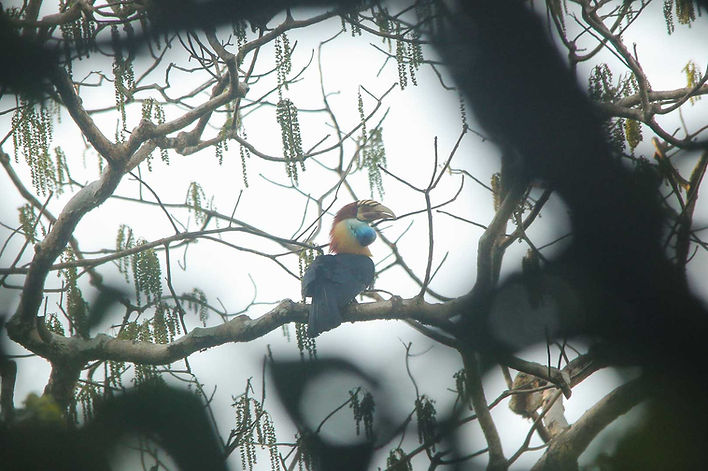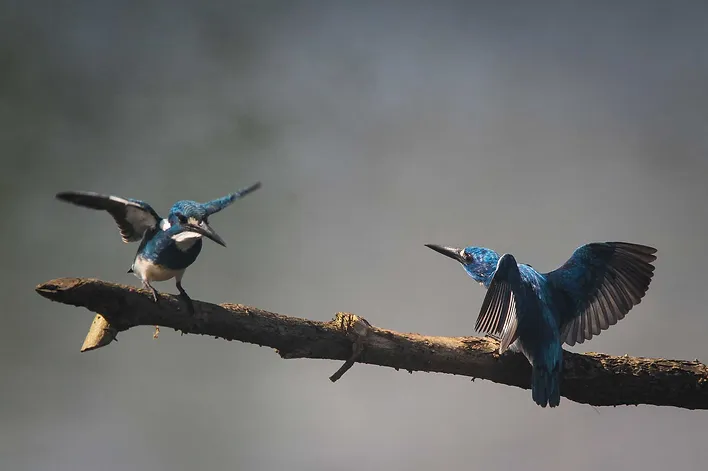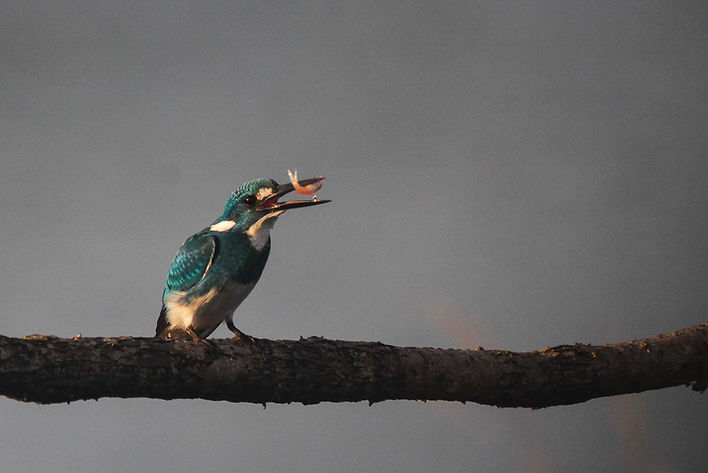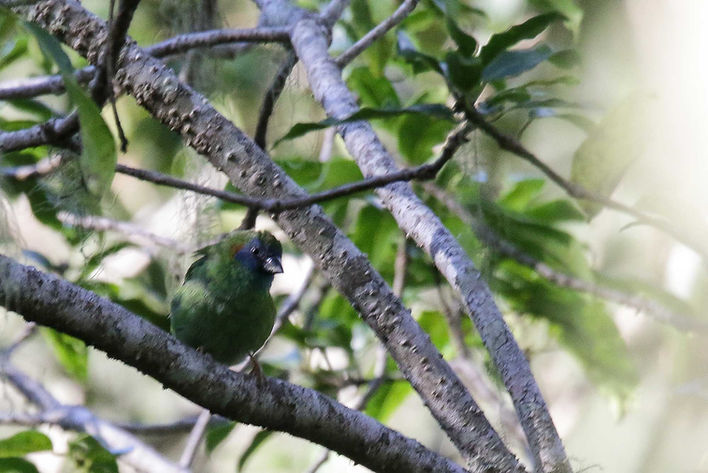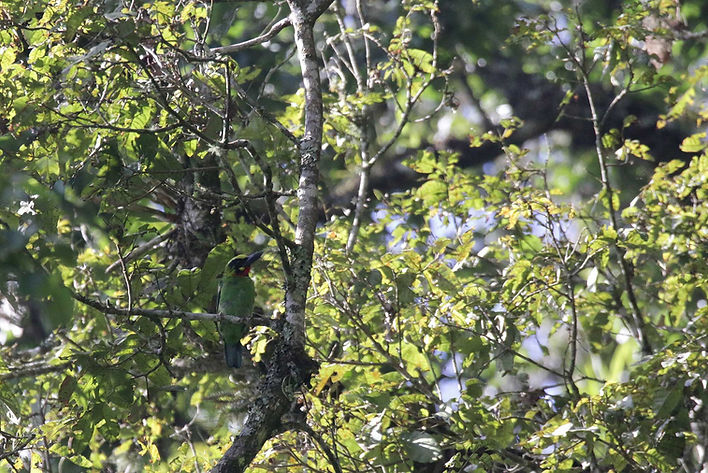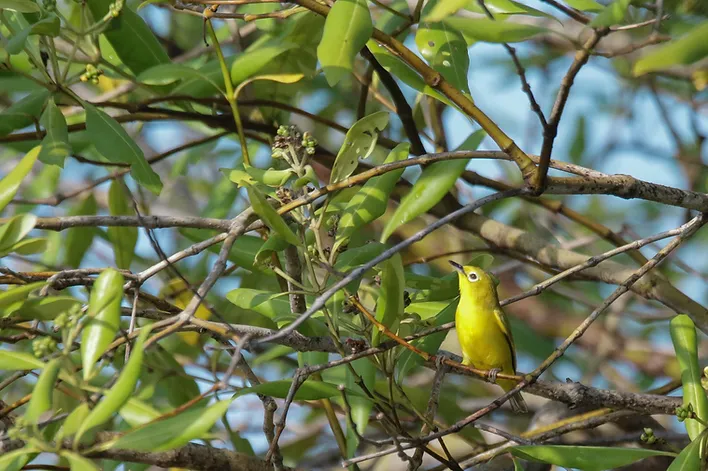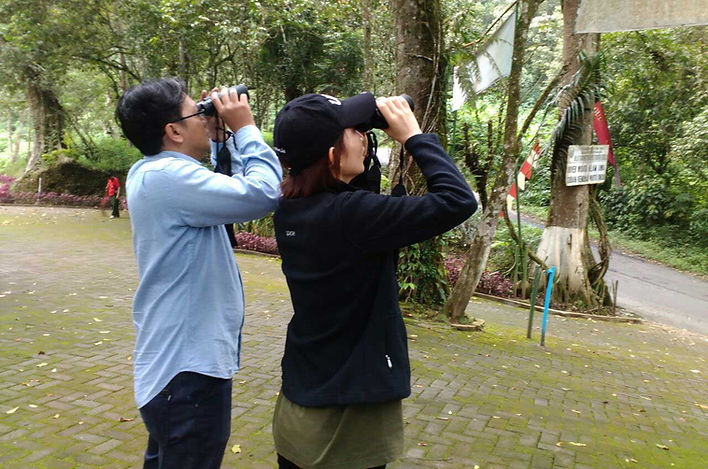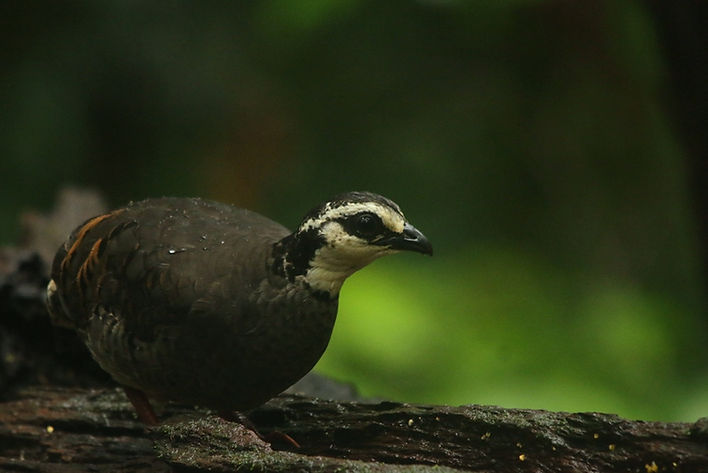
Easy encounter of Grey-breasted Partridge (Arborophila orientalis) on this site!

Almost all endemic birds in Java island can be found in western part of this island. Birders will stay longer to swipe up on them in Gede Pangrango NP, Halimun Salak NP, around Carita and north-coast of Jakarta-West Java.

Even so, still left 2 species to catch up in eastern Java to complete all endemics. There are Grey-backed Myna Acridotheres tricolor and Grey-breasted Partridge Arborophila orientalis.

The myna is relatively easy to find. You can put effort in Baluran or Alas Purwo NP to find it.

The partridge is another exception.

You can hear it sounds loudly, but it is very difficult to see. So damn elusive species.

This species lives from Yang to Ijen mountains. Most birders came to Ijen, which is close to other main birding areas, so much data of this species is even heard-only or sight.

Yesterday (March 13, 2019) I visited Mt. Ijen took some pictures of the partridge.

Local guides at their successful made feeding site for this species that is also known as White-faced / Grey-breasted Hill / Horsfield’s Hill-partridge.

As his information, the birds show up about 3 times such as at around 06.00-07.00, 13.00-14.00, and 15.00-16.00.

Heavy rainfall in the morning until 11.30 then becomes shower rain.

We entered the site at 12.00.

While waiting for the rain to stop, we enjoyed our coffee.

At 13.30 the rain stopped for a while, so we tried to play the sound records.

15 minutes later, a medium sized-bulky bird (about 28 cm) climbed up to a big fallen tree in front of us.

Then followed by 5 other birds, it was a very clear view and just about 8 meters away from us was blocked by a camouflage tent.
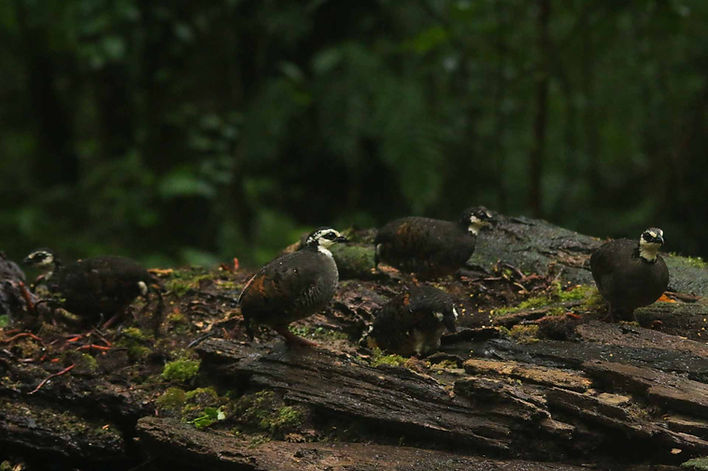
5 of 6 Grey-breasted / White-faced Partridge from Mt. Ijen, East Java

A group of Grey-breasted Partridge foraging the meals which we have put before.

We’re just silent while clicking the shutter of the camera.

They spent 10 minutes foraged then disturbed by other birds, such as Javan Whistling-thrush, Horsfied’s Thrush, and Snowy-browed Flycatcher.

The final encounter that day was a single female almost eaten by Javan Mongoose at 16.30. It’s run away then we also pack our stuff, out from the hide and head back to home.

Now this elusive partridge is stable and easy to see, drop us a message if you want to encounter this mega target of East Java endemic.
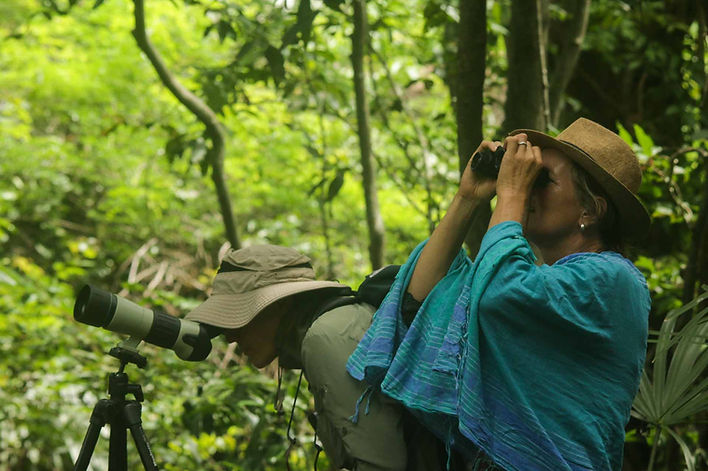
One-day Birding Trips in Baluran National Park

This was a one-day birding trip that planned suddenly when we were still on a trip to Probolinggo. Our British clients asked to do so in Baluran NP on January 24, 2019.

The trip started at 06.00 am by meeting up at their accommodation next to the national park. We drove into the national park and stop-by for look at the birds. In the morning the weather was bright even though it’s in the rainy season. Baluran is famous for its dryness with yellowish vegetation but on this trip, it all looks green and dense.

As planned we stopped in the middle of the journey to Bekol, where there was a bird perched on a tree. Rushed out of the vehicle then saw binoculars to identify it. The bird is an Orange-breasted Fruit-dove. Then from behind us, there were 3 birds that were the same as the ones we saw at the beginning. Slowly the sounds of the birds around us were heard and one by one began to appear.

Sooty-headed Bulbul, Yellow-vented Bulbul, Island Collared Dove, Long-tailed Shrike, Cave Swiftlet, Common Tailorbird, Black Drongo and Racket-tailed Treepie nailed to identify.

Before the birds get low, we continue to drive in. Not long after, a Green Junglefowl crossed the road in front. We really got a clear view from this striking male. The Green Junglefowl is plenty and easy to find in Baluran, while the Red Junglefowl is less frequent, but we managed to see a male who was scavenging the ground in a roadside bush.

At 08.30 am we arrived in Bekol savanna or at this moment better to mention the Bekol grassland. Not too many visitors around, also birds begin to quiet as the intense sun. We only saw Spotted Dove flying and noisy Common Iora. Slowly head towards Bama beach.

In the middle of the Bekol-Bama road, we stopped to look around. On the north side, there is a dead Gebang tree and there are several holes in the top. Suddenly there was a medium-sized black-and-white bird coming out of the hole. Moments later the object landed on the tree for a long time, we managed to recognize the bird was Grey-backed Myna.

Grey-cheeked Tit-babbler in Baluran NP. It is endemic to Java island.

Our clients were very happy to meet this critically endangered species after encountering the Junglefowl earlier. Satisfied with the Myna, the journey continues until Bama beach.

Before entering the Bama coastal forest, stop in the small canteen for coffee and tea. At 9:30 a.m., I began to walk into the Bama beach forest bird watching trail. Slowly one by one we saw the Oriental-pied Hornbill. Its size is quite large, noisy, in groups making it easy to see at the dense canopy of the Bama beach forest.

Suddenly the dominant red-sized small object flew around us and then landed 300 meters in the bush right after us. When it’s perched, it’s clearly visible through binoculars and scope, birds with long; straight and dagger-like bill; short legs. An Oriental Dwarf Kingfisher, another delightful sighting that day.

Other birds we saw here were Grey-cheeked Tit-Babbler, Green Imperial Pigeon, Cerulean Kingfisher, and Olive-backed Tailorbird.

The sky began to turn into black clouds at 1:00 p.m. With 23 bird species on record we decided to end this trip and rush out of the national park to our clients’ lodging with satisfaction.

Delightful view of pair Oriental-pied Hornbill

2 Days Birding Trips in Probolinggo & Surabaya, East Java

We had clients on the Holland America Noordam cruise ship which arrived in Probolinggo on January 22, 2019 and Surabaya on the next day. They want to take birding trips programmed during the docked ship in those cities.

First location on day one is around the north-west area of Mt. Argopuro. The habitat is agro-forest and stream. We got a problem with the tender that delivered our clients to the lands, and finally started driving very late at 10.00 am. Arrived at 12.00 am then began to look at the birds.

Spent 2 hours here then drove back before 04.00 pm that the ship will leave Probolinggo headed to Surabaya. At least we managed to see the highlight: a pair of Javan Sunbirds foraged in a coffee plantation.

On the next day, we met at the Port of Tanjung Perak in the north of Surabaya at 08.00 am. Then we drove for one hour to get to the Wonorejo mangrove and fishpond area. Due to the rainy season, the track was muddy. We got much time here for 4 hours birding but must walk slowly around the fishpond and mangrove until 01.30 pm. Highlight in here is: plenty of Javan Plover foraged at mudflat next to small canteen.

Birding in Fishpond and Mangrove area of Wonorejo, Surabaya

At 01.30 pm we started to drive back to Surabaya North Quay where the Maasdam ship docked and the two days birding trips in Probolinggo and Surabaya, East Java ended.

Other Included: Cave Swiftlet, Javan Pond Heron, Striated Heron, Little Black Cormorant, Purple Heron, Little Egret, Eastern Cattle Egret, Common Moorhen, Red-necked Stint, Long-toed Stint, Spotted Dove, Collared Kingfisher, Pasific Swallow, Malaysian Pied Fantail, Scarlet-headed Flowerpecker, Scaly-breasted Munia.

Photo groups in Kalianan village, Probolinggo

2 Days with White-capped Munia in Jogja

Get good weather at the beginning of December 2018 which is already in the middle of the rainy season, located in Yogyakarta or simply Jogja for a 2 days birding trip. The location is in the Banaran village, Galur sub-district, Kulonprogo regency, Yogyakarta close to Trisik beach and the Progo River estuary.

I visited paddy-fields that are very large which are dominated by rice plants with a planting age of around 10-50 days on December 1st 2018. There is one bird species I look for, indeed endemic to Java and Bali islands.

Head-shot White capped Munia among young rice plants

It’s small sized passerines (11–12 cm ) with short bill, short rounded wings. Forehead to the nape and face are whitish. Upperparts chestnut, edges of uppertail-coverts and central rectrices reddish to reddish-yellow. Iris dark brown, eyering dark grey; bill light grey; legs grey.

Glimpses like White-headed Munia with the most distinguishing are chin to breast black, flanks broadly rufous extending across lower breast to form rufous band, belly to undertail-coverts black; more rarely, entire underside from chin to vent (including flanks) black.

This species is White-capped Munia (Lonchura ferruginosa), that can only be found in grasslands, wetlands with grasses, reeds and sedges (Cyperaceae), rice fields of Java and Bali islands.

Adult White-capped Munia (Lonchura ferruginosa)

I had a chance to chat with the local farmers, evidently they could distinguish the kind sof Munias around the rice fields of Banaran village. In this area, the birds are easier to see in the rice planted season. It will be more often after rice grains first appeared, about 25 days of planting.

“The birds like starch in young rice grains and grass seeds around the paddy-field. After the harvest season, this bird will disappear and return during the next rice planting season” Said local farmers.

Foraging groups White-capped Munia

On the second day I was still watching this bird, lucky to find that one was carrying a stem of grass that seemed to be used to make a nest. Follow the bird until it disappears in the dense vegetation next to the paddy-field area.

The rice fields in Banaran provide foraging and nesting locations for this species, hopefully it will be sustainable so that many generations can see this endemic.

White-capped Munia carrying stems grass

To see birding in detail around Jogja, please follow this link below or click on the related post on the side bar.

Trip Report of 3 Days Birding in Sumba, October 2018

First birding trip in Sumba island for clients from Lombok has gone smoothly. During October 7-9, 2018 we birded in two locations Billa and Lewa (part of Manupeu-Tanadaru-Laiwangi-Wanggameti or simply Matalawa NP).

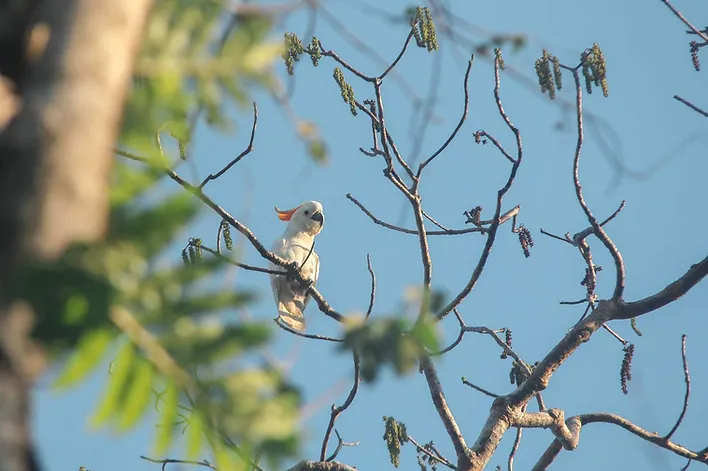
One of two Citron-crested Cockatoo from Billa

Birding in the peak of the dried season is another challenge. After landing in Umbu Mehang Kunda airport then transferred to Billa for 5 drive hours. Stop by 2 hours before arriving for a short afternoon birding along the roadside of Lailara. There were 10 fruiting calabur trees Muntingia calabura that were often visited by Sumba Flowerpecker.

The remaining 2 hours before arriving in Billa was a bumpy road, wisely we used four-wheel-drive. It was also useful for exploring the birds inside the park.

Quickly when arrived, then birded at night looking for the owl. Until 9 pm we just hear the songs of Little Sumba Hawk-owl and Greater Sumba Boobook. Decided to take a rest in the ranger office. In Billa there are only 2 options for staying, camping inside the park and living with the rangers in the huge office building.

Male Sumba Flowerpecker enjoyed fruit of Calabur tree

After breakfast we entered the clearing area in Billa. It was good when the birds started actively singing while sun-bathing. Then quickly follow the dried river. At midday we went back to the office for lunch, before entering the park once again we saw Short-toed Serpent-eagle perched at top of Kapok tree’s next to the office.

From afternoon until 9 pm continue birding in Billa to get another chance that we missed before. We birded along a dried river with small pools, and at night finally encountered Little Sumba Hawk-owl and a short view of Greater Sumba Boobook.

Male Sumba Hornbill encountered near its hole nest

We have half a day to birding in Billa on 9 October before we move to Lewa. In the morning the weather was good as the day before. Starting at the entrance gate, we found a fruit tree which 10 bird species foraged. Some species that we missed yesterday nailed at that spot.

The last half day was spent in Lewa for owling. We just visited two locations here, Langgaliru forest and road-side-forest near the ranger office. Starting before dark until 9 pm, we nailed to see two endemic Booboks.

One of three nightbirds which good captured, Little Sumba Hawk-owl

Then, here our highlights of the trip:

  • Little Sumba Hawk-owl (Ninox sumbaensis) – A single close view in Billa and a pair perched on a canopy at Lewa.
  • Sumba Hornbill (Rhyticeros everetti) – A male perched on a tree near its nest hole.
  • Sumba Flowerpecker (Dicaeum wilhelminae) – Two pairs foraging on roadside 2 hours before Billa.
  • Citron-crested Cockatoo (Cacatua sulphurea citrinocristata) – In the afternoon we saw 2 perched and singing loudly in Billa.
  • Sumba Brown Flycatcher (Muscicapa segregata) – Single birds perched on top canopy in Billa.
  • Greater Sumba Boobook (Ninox rudolfi) – Three individuals calling each other on the road-side of Lewa.
  • Red-naped Fruit-dove (Ptilinopus dohertyi) – Single bird posed nicely in Billa.
  • Sumba Jungle-flycatcher (Cyornis stresemanni) – 1-2 birds at entrance gate Billa.
  • Apricot-breasted Sunbird (Cinnyris buettikoferi) – Male and female foraged near entrance gate Billa.
  • Sumba Green Pigeon (Treron teysmannii) – Pair flight above clearing area in Billa and 1 perched on top tree at Lailara.
  • Sumba Flycatcher (Ficedula harterti) – Single bird jump into the bushes at dried river, Billa

Other included: Cinnamon-banded Kingfisher, Chestnut-backed Thrush, Pale-shouldered Cicadabird, Tenggara Swiftlet, Short-toed Snake Eagle, Marigold Lorikeet, Red-cheeked Parrot, Great-billed Parrot, Spotted Kestrel, Orange-footed Scrubfowl, Common Emerald Dove, Black-naped Fruitdove, Green Imperial Pigeon, Eclectus Parrot, Mee’s Nightjar, Oriental Dwarf Kingfisher, Grey-headed Canary-flycatcher, Spectacled Monarch, Arafura Fantail, Yellow-ringed White-eye, Ashy-bellied White-eye, Indonesian Honeyeater, Helmeted Friarbird, Five-colored Munia, Short-tailed Starling, Wallacean Drongo, Slender-billed Crow, Rusty-breasted Whistler, Broad-billed Flycatcher, Green Junglefowl.

Gallery:

Kingfisher Trip Around Malang, East Java

Finished accompanied by a friend from Hong Kong to photograph Kingfisher around Malang, East Java. During April 26 – 29th 2018 we visited four birding locations.

The main target of this trip is the Indonesian endemic, Cerulean Kingfisher Alcedo coerulescens which can be found in Streams, canals, ponds, swamps, tidal estuaries, mudflats, mangroves, fish ponds, flooded paddyfields; from coast up to 800 m along South Sumatra through Java, Kangean Is and Bali to Lombok and Sumbawa; recorded also on Flores.

On the first day, Kevin and I met at Javan Banded Pitta’s site in Tretes, East Java that was managed by Heru Cahyono (Malang Birding Tours) in the afternoon. Before dark we move to a hotel in Batu city, dinner on the way.

Starting early in the morning we visited Batu Apple Farm to take pictures of Javan Kingfisher until 8.00 am. We have to hurry to reach the main target location on the south coast of Malang.

Javan Kingfisher with prey in Batu city, East Java

After lunch we arrived, then put up camouflage-tent around the fish-pond which is our favorite perch for.

About 30 minutes later, Cerulean Kingfsiher perch in 8 meter ahead. Along the afternoon the shutter was not stop clicking.

On the last day, we only have time until lunch time for the last target in the estuary area of south Malang. Ruddy Kingfisher.

The main target Cerulean Kingfisher with prey

Ruddy Kingfisher Halcyon coromanda has widespread distribution, from NE China through Sulawesi island.

In Java (H.c. minor) this species has a few records, seems rare to find. In Kondang Merak, south Malang has many records compared to other locations in Java island but still challenging. The race minor is very small than the other, much darker, washed with violet, large silvery rump patch.
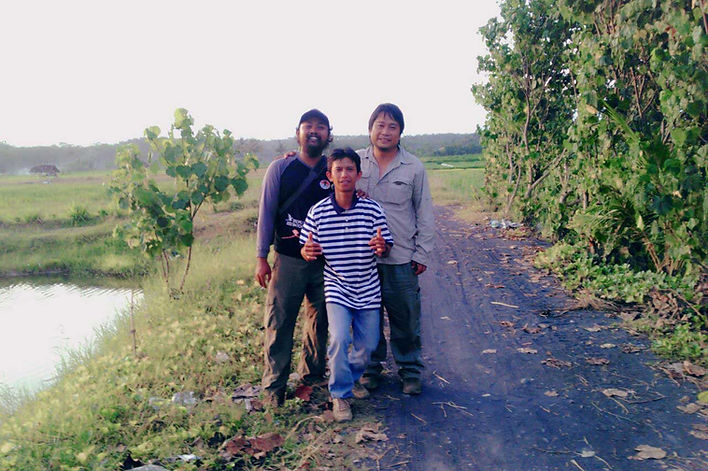
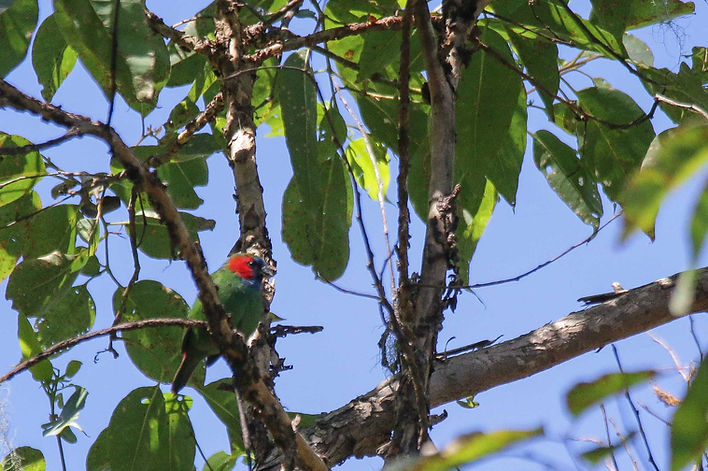
Quickly we waited in the location which usually this bird encountered. We were disturbed by the passing of other visitors, several of them curious with us. Until really quiet at around 10.30 am the Ruddy Kingfisher appeared.

Ruddy Kingfisher from south Malang, East Java

Kevin took many shots, he even had time to change lenses because the birds perch to close about 3 meters away.

2 hours stayed in front of the tent, until Kevin was satisfied, then we had a long drive to his hotel in Surabaya before he took off back to Hong Kong the next day.

Satisfied after got the main target

REDISCOVERED the Mutis Parrotfinch in West Timor, Indonesia

In the book of “Birds of the Indonesian Archipelago – Greater Sundas and Wallacea” written by Eaton J., et al which was published in 2017, stated that there are 18 species of birds that have not been scientifically described. Of these 16 are split species and the two remaining are newly discovered.

One of them is “Mutis/Timor Parrotfinch” Erythrura sp. nov, which was first discovered and documented by James Eaton in the Euclyptus forest around Mount Mutis, West Timor in 2012. After the first encounter, other birders also tried to find this parrotfinch without a legal Indonesian name in the same location, even some researchers who try to get holotype to be officially described.

On August 12, 2018, the birdpacker team (Swiss Winasis, Waskito Kukuh and Nurdin Setio) visited Fatumnasi village which is located at the foot of Mount Mutis. Guided by Sam, son-in-law of local village chief Mateos Anin, we tried to explore the birds there with the main target “Mutis Parrotfinch”.

Sam often guides overseas bird watchers, showing that some of the main locations that are commonly visited to see the parrotfinch which perhaps most closely resemble Red-eared Parrotfinch E. coloria that are currently only known from Mindanao in the Philippines, 2,000 km away.

The book states that this parrotfinch is usually observed alone or in pairs and rarely mixes with Tricoloured Parrotfinch E. tricolor which is quite common in West Timor. The place for food its foraging almost the same, from the bottom of the forest, shrubs to Eucalyptus top canopy. So far, this bird is found at an altitude of 1400-1850 asl.

It is quite difficult to find this bird, its small size; green dominant body; and the sound is very similar to its brother. Starting from morning to noon we visited 3 spots that usually have some records. Until we decide on the 4th spot to wait longer until late afternoon.

While making coffee and instant noodles on the spot while sharpening your ears and eyes, prepare for the sound or appearance of the main target. Until the supplies we make are finished and packed, we have not seen it coming. Then we decided to go back and repeat the luck tomorrow.

However, just shifted about 50 meters suddenly Sam and Swiss, who happened to walk more in front stopped and then lifted the camera. The shutter starts to sound without a word mentioning the name of the bird.

Waskito and Nurdin just kept quiet and did not make disturbing movements. After a while there was a small green object from the bush flying up to the middle canopy then perched on one of its branches. Simultaneously the two people behind lifted the binoculars and cameras slowly. Together the shutter flare alternately sounds for almost 2 minutes. After that, the object flew leaving the four of us, spontaneously we immediately shouted relieved that the object was a adult male Mutis Parrotfinch who we were looking for all day. “Yeeaaaahhhh … !!!”

Adult female Mutis Parrotfinch encountered in second day near the same spot
Adult female Mutis Parrotfinch encountered on the second day near the same spot.

On the second day, we tried again to repeat the same place earlier and pass by shortcut to arrive quickly. About 100 meters before the destination, we met female birds completing our search for a mysterious parrotfinch from the mountain forest of Mutis.

The difficulty of finding this bird is, like the literature, it moves solitaire; small size with ripe green; and a sound that is almost similar to the Tricoloured Parrotfinch “psssttt … psssttt” in flight. But it can be guarantee, this bird really exists!

Birding in Cangar Hot Spring with Friend from England

We have been visited by friends from England during his research in Java, Indonesia. He accompanied by local teams drove to our base-camp in Batu city, East Java. Suddenly the next day (July 7th 2018) we went to the Cangar hot spring part of Tahura R. Soeryo, indeed for birding!

With 9 people in the group, we started looking at the birds around the Cangar hot spring. The weather was so good and very cool for us, but not for Harry.

Any tourist attractions would be visited by many visitors. We also experienced that condition on that day. So we tried to hike in a jungle track behind the hot spring.

The length of the circular track is about 1 Km, with a fairly steep incline at the beginning and before half the length of the track.

We stopped for a while in front of a Japanese cave, scanned all directions and paid attention to every movement of leaves or twigs, hoping there was a bird behind the movement.

The pace of the trip was so dynamic, at the beginning we just saw a few bird species then after leaving the Japanese cave, we were stopped by a mix flocks. Then when we are at the half of the track, the birds become low again until the end of the track.

One of 4 Javan Yellownapes in Cangar Hot Spring

Orange-breasted Trogon was the main target for Harry, but only 3 of us successfully encountered it and made Harry Jealous.

This happened when I invited Harry and 5 other friends to chase the bird’s sounds, while three other friends waited on the main track. When we were near the source of the sounds, the bird even went out to near 3 of our friends.

Highlights of the day were:

1. Four individuals Javan Yellownape Chrysophlegma mentale.

– Saw around Japanese Cave, possibly 2 young and a pair of adults.

2. Pink-headed Fruit-dove Ptilinopus porphyreus

Single female bird near the Japanese Cave

3. Black-banded Barbet

Single bird near the Japanese Cave and 2 before half of the jungle track.

The rest of bird-list is below.

I invited the groups for lunch in Sendi, to taste local food called Nasi Jagung (corn rice) equipped with salted fish, tofu, tempe, water spinach and sambal. Then we moved to jembatan Cangar (Twin Bridge) for dessert, which was Tape Ketan (fermented black sticky rice).

Black-banded Barbet, endemic for Java

While we enjoyed the dessert, we waited for the Javan Hawk-eagle. Sadly the birds was not shown, only a single male White-flanked Sunbird seen by me.

At around 2.30 pm, we agreed to finish the trip and head back home.

Although birding this time was quite chaotic, at least Harry got 3-4 lifers and enjoyed the birding and also the food on the sidelines of his research.

Bird List of Cangar Hot Spring – July 7th 2018

No.English NameScientific Name
1.Sooty-headed BulbulPycnonotus aurigaster
2.Eastern Spotted DoveSpilopelia chinensis
3.Long-tailed ShrikeLanius schach
4.Javan Grey-throated White-eyeHeleia javanica
5.Lesser ShortwingBrachypteryx leucophris
6.Horsfield’s BabblerMalacocincla sepiaria
7.Ashy DrongoDicrurus leucophaeus
8.Sunda CuckooshrikeCoracina larvata
9.Javan YellownapeChrysophlegma mentale
10.Pink-headed Fruit-dovePtilinopus porphyreus
11.Cave SwiftletCollocalia linchi
12.Flame-fronted BarbetPsilopogon armillaris
13.Black-banded BarbetPsilopogon javensis
14.Javan WarblerPhylloscopus grammiceps
15.Javan BulbulIxos virescens
16.Javan Whistling-thrushMyophonus glaucinus
17.Ruddy Cuckoo-doveMacropygia emiliana
18.Javan Banded PittaHydrornis guajanus
19.Orange-breasted TrogonHarpactes oreskios
20.White-bellied FantailRhipidura euryura
21.Little Pied FlycatcherFicedula westermanni
22.Indigo FlycatcherEumyias indigo
23.Sunda MinivetPericrocotus miniatus
24.Blue NuthatchSitta azurea

The Best Site to See The Survived Population of Javan White-eye in Java

On July 21st 2018 we had a client from the US looking for the main target, the Javan White-eye (Zosterops flavus) that is found only in west & south of Borneo, coastal north of Java and Madura.

Due to the massive hunting and poaching of all kinds of white-eye’s species, the population in the wild is in a crazy decline. Sounds like critically endangered.

Khaleb Yordan told us that the last time he saw this endemic white-eye in western of Java was 2 years ago. Yesterday was a reunion for him, also lifer for Mr. Russell Graham.

We saw more than 6 individuals in the safe area since the people around here are educated well for conservation of wildlife.

We started birding that day after leaving Juanda international airport, Surabaya, East Java. The location is not too far away, it takes about 30 minutes from the airport. At 6.30 am we went to a location called Wonorejo. This is a huge fish-pond and mangrove area.

On the first stop, before the parking area we tried looking at Sunda Coucal. Usually, it’s perched on tree or bushes top for sun-bathing. Sadly, the birds were not shown and we did not hear the sounds.

At least a male Freckle-breasted Woodpecker is perched on a dried branch. We don’t want to miss it.

Following the Javan White-eye movement.

Then we walk slowly, a clear call of Cerulean Kingfisher attracting us. For sure, a single bird perched in front of us, divided by the river. The kingfisher was perched on a bush near the water surface. Then it flies, responding to the other kingfisher’s calls.

We move to the parking area and prepare our stuff to get inside. But, we have to take time around the Muntingia calabura tree.

3 individuals of Scarlet-headed Flowerpeckers foraging on that tree. Our client pulled up his binocular to add it into his life-list. Bravo! new lifer again.

Satisfied with it, we continued walking to pursue our main target.

Walk for about 500 meters inside through fish-pond and mangrove trees. Then we played the Javan White-eye’s sounds. We heard the response at a mangrove tree that was full of Cave Swiftlet. This was also new for him.

We approached the tree and found the object. Voila! our ears were correct, four individuals gleaning its prey below the mangrove’s leaves at the middle canopy.

The Javan White-eye foraging in mangrove tree

Hang out and enjoy the birds also following its movement while watching other species until our clients are satisfied.

At 8.30 am we moved out to warung (small canteen) near the parking area. After taking a break for a while we continued again to other directions. But the number of birds was low and no new birds were added to the list. So we ended the trip and started driving to the airport.

Highlights:

  1. 6+ individuals Javan White-eye (Zosterops flavus)
  2. A male Freckle-breasted Woodpecker (Dendrocopos analis)
  3. 5 individuals Cerulean Kingfisher (Alcedo coerulescens)
  4. A pair and 1 immature male Scralet-headed Flowerpecker (Dicaeum trochileum)
  5. Single adult Javan Tailorbird / Olive-backed Tailorbird (Orthotomus sepium)

Other birds are included such as:

Javan-pond Heron, Purple Heron, Cattle Egret, Little Egret, Striated Heron, Great Egret, White-shouldered Thriller, Spotted Dove, Island-collared Dove, Sacred Kingfisher, Javan Plover, Common Sandpiper, Whimbrel, Whiskered Tern, Little Tern, Gull-billed Tern, Black-winged Stilt, Golden-bellied Gerygone, Little Black Cormorant, Sunda Teal, Racket-tailed Treepie, Cave Swiftlet, Scally-breasted Munia, Eurasian Tree Sparrow.

Other Taxa:

Javan Mongoose

Fullday Birding in Malang, East Java

On fine morning (May 16th 2018) we managed one day birding trips on Malang, East Java for a couple clients from Indonesia. 19 species succeed to observe from two birding locations such as Batu Apple Farm and Raden Soerjo Greater Park Forestry.

Our first stop was at Apple Farm for Javan Kingfisher. Not to long wait, we were immediately greeted by a Javan Kingfisher after parking our car. For 30 minutes in location, four individual Javan Kingfishers recorded. Other than that we recorded Common Tailorbird, Sooty-headed Bulbul and Yellow-vented Bulbul.

Satisfied in the first location, we continued the trip to the second location that made us drive for 30 minutes. In that tropical rain forest we managed to find Sunda Cuckooshrike, Cinereus Tit, Snowy-browed Flycatcher, Sunda minivet, Scaly-breasted Munia, and Blue Nuthatch.

Then we moved to another area of the park in Watu Ondo waterfall. Montane birds such as Sunda (Javan) Bulbul, Orange-spotted Bulbul, Ruddy Cuckoo-dove, Flame-fronted Barbet, and female Little-pied Flycatcher accompany us to enjoy the breeze atmosphere. We decided to climb down toward the waterfall for a moment.

For lunch, we chose a small restaurant around the area to taste local traditional food. After that we hang out at twin bridges waiting for more birds, hoping the Javan Hawk-eagle will appear. Failed to wait more because the afternoon was getting cloudy, so we decided to finish the trip with birds closing the day such as Javan Grey-throated White-eye, Ashy Drongo, White-flanked Sunbird and Indigo Flycatcher as our client’s favorite.